How to ditch AppleScript and use Ruby instead

Matt Neuburg has put together a great article full of examples of using Ruby and AppScript in place of AppleScript to script operations under OS X. I hadn't bothered to try these Ruby->OS X bridges yet, but I followed Matt's simple examples with amazement. It's so simple! Within two pages Matt moves on to using Ruby to instruct Microsoft Excel to produce a graph based on data provided from Ruby and it'll only take you up to ten minutes to read the whole thing and get that far. Excellent piece.

Read more →

ED for Windows: Another established IDE adds Ruby support

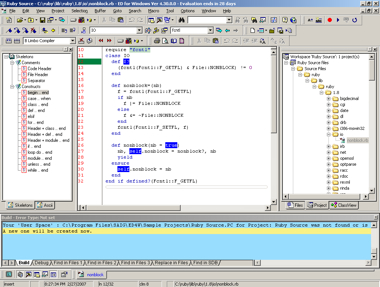
Ed-Ruby

I'm not a big IDE or a Windows user myself, so getting me to review a Windows-based IDE could be quite tough. However, the creator of ED, Neville Franks, is an Australian-based independent software developer (trading as Soft As It Gets) and wrote such a nice e-mail that I felt obliged to take a look.
ED is a Windows-only editor with over 20 years' of history, having first been commercial released in the 80s, crammed with features a lot of developers seem to love, and with support for about twenty different programming languages out of the box. The latest is Ruby which Neville has so far been impressed with. ED performs code completion (ending of blocks, if statements, etc), syntax highlighting, class navigation, and all of the features you'd usually expect an IDE to boast. Neville has written a comprehensive blog entry covering ED's support for Ruby, where he demonstrates each of these features.

Read more →

Skype-Style Firewall Busting with Ruby and UDP

Skype and Google Talk are pretty clever in the way that they still work even if all of its users are behind firewalls (or NAT systems) that block incoming connections. The way they enable two-way connections is by using a 'firewall busting' technique. Simply, a central server does nothing but share IP addresses (and port numbers) and clients can then 'punch' holes through their firewalls and trick their firewalls and routers to route incoming packets back to them if they have certain source host and port numbers.

Read more →

Making The Existing Ruby Interpreter Faster

A lot of people seem to want to reinvent the wheel where Ruby is concerned, and I wish them all luck, but Tomasz Węgrzanowski has taken the unique step of trying to make the existing C-based Ruby interpreter faster instead, with intriguing results.. He even goes as far as to hack Ruby's source code to remove inefficiencies in how Fixnum objects are compared. I totally dig this and would love to support further efforts to implement non-damaging optimizations to the existing interpreter.

Read more →