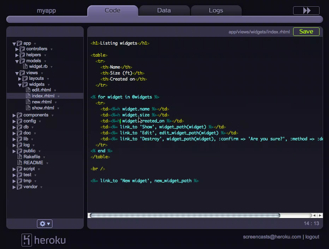
Heroku: An Online Rails Development and App Hosting Environment


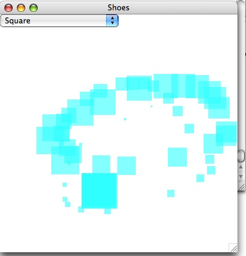
Will Larson has put together a great "from start to finish" tutorial on building a graphical application on OS X using Shoes, the cross platform GUI library by whytheluckystiff. It goes right from explaining what Shoes actually is, through to its installation, some basic examples, and then to building a basic graphics-focused application.

Thomas Enebo of the JRuby team has announced the release of the first beta of JRuby 1.1. This is a significant release, focusing heavily on performance increases. The performance increases yielded so far are so significant that in most like-for-like tests, JRuby beats the regular Ruby interpreter (a.k.a. MRI) JRuby 1.1. On Rails-focused tests, JRuby also wins.. making JRuby the fastest way to run Rails applications at present. Charles Nutter talks about the improvements, along with a number of other interesting JRuby-related topics, in his latest blog post - a must read for Ruby implementation nuts.
As long time readers will know, Ruby Inside has its own jobs board at jobs.rubyinside.com. It doesn't just have jobs posted only by Ruby Inside readers, but also jobs scraped from all over the Web with many Ruby and Rails related jobs being picked up every day (e.g. how does being a Ruby Engineer in Los Angeles take your fancy?).

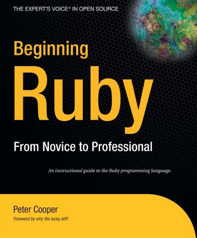
Thanks to an article called "Top Programming Books on Google Book Search", I've discovered that many of the pages of my book, Beginning Ruby (available also in e-book format here), are available here on Google Book Search. Most of Chapter 3 is there, along with chunks of every other chapter, including quite a bit of Chapter 16, a reference of "Useful Ruby Libraries and Gems".

Thanks to Jan Wedekind for letting me know that the Ruby Association, a formal Ruby promotion group chaired by Matz himself, has chosen a winner in the Ruby Logo Contest. The winning logo is by Tom Schaub and licensed under the Creative Commons Attribution-ShareAlike license.

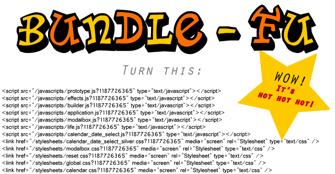
Bundle-Fu is a new plugin by Tim Harper that can bundle CSS and JavaScript content from separate files into one file each automatically to reduce the amount of <scrip> and <link> includes required on the pages within your Rails applications.


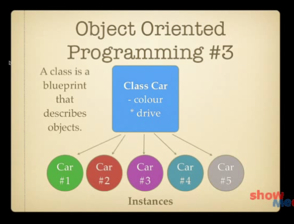
A few weeks ago, Peter Vanbroekhoven of the newly formed Belgian Ruby User Group gave a presentation called Metaprogramming in Ruby (video and slides available). Peter looks at some of the metaprogramming voodoo used by libraries like ActiveRecord and looks at how to create domain specific languages of your own.

In "How the Ruby heap is implemented," Hongli Lai looks at how Ruby manages its memory and stores your objects. It's reasonably technical but a very interesting read for those with the stomach for it.