Thanking Ruby Inside’s September 2011 Supporters
 Ruby Inside wouldn't be what it is without you but it's time for me to thank the companies who also help to keep Ruby Inside going by sponsoring my work. Thanks!

Ruby Inside wouldn't be what it is without you but it's time for me to thank the companies who also help to keep Ruby Inside going by sponsoring my work. Thanks!
 On August 1, 2011, Ruby 1.9.3 preview 1 was released. The final version isn't yet out (as of September 23) but Ruby 1.9.3 is going to be the next, full production-level release of MRI Ruby. But what's the deal with 1.9.3 (and its successors, Ruby 1.9.4 and 2.0)? Keep reading!
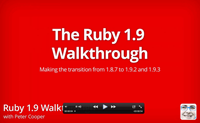 In a presentation about Ruby 1.9.3, Yuki Sonoda notes that Ruby 1.8 has "no future" and its "end of life" is being discussed pretty seriously. Ruby 1.8 is becoming history, but what's the alternative? Why, Ruby 1.9! :-)
 Despite RSpec's awesomeness, Test::Unit remains the most popular Ruby testing tool out there outside of Rails apps. I've recently been code walking through a lot of Ruby libraries for my Ruby Reloaded course and the typical arrangement is Test::Unit, sometimes coupled with Shoulda or Contest for some extra syntactic sweetness.
 It seems the Ruby and Rails job scenes are on fire! I don't remember running so many jobs across a single month before. 22 Ruby and Rails jobs are here and they're spanning the world. US West Coast, East Coast, England, Scotland and Germany are all represented. It's definitely not the common "San Francisco or nothing" roundup :-)
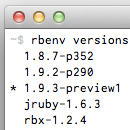 rbenv is a new lightweight Ruby version management tool built by Sam Stephenson (of 37signals and Prototype.js fame).
 Between August 19—20, 2011, Madison, Wisconsin plays host to thirty-seven speakers and panelists to discuss Ruby, OSS, and community in the form of Madison Ruby Conference. Speakers include Jeff Casimir, Giles Bowkett, Bryan Liles, Sven Fuchs, Steve Klabnik, Brian Hogan, Jacqui Cox, Lori Olson, Gerred Dillon, Barry Hess, and Chad Pytel amongst others.
 In the past couple of months I've seen situations arise where developers aren't entirely sure how Ruby has chosen to interpret their code. Luckily, Ruby 1.9 comes with a built-in library called Ripper that can help solve the problem (there's a 1.8 version too, see later). Here, I give the 30 second rundown on what to do.
 Official project sites should set the benchmark for standards relating to that project in terms of the best quality and most up to date news updates, documentation, download links, tutorials, and so forth. On this front, Ruby's official site at ruby-lang.org is doing a bad job (in the English language variant, at least).

 I don't like being negative on Ruby Inside without good reason. Trivia like DHH's test library preferences can provide a fun talking point but pointing out specific flaws in someone's work is rarely insightful.
 Over on the