Working With Video From Ruby


 A week ago, in a story published by eWeek.com, Darryl K. Taft asked "Can Ruby and Rails Make Developers Shine in a Downturn?"
 Giles Bowkett is anything but a quiet chap - indeed, he's one of the more outspoken members of our community. With the roar, however, comes a lot of wisdom, and Giles recent work on integrating Ruby and MIDI is inspired.


More jobs - more opportunities! It's not entirely Rails-only opportunities this time around, although all the positions are in the US (primarily in San Francisco). The Ruby Inside Job Board (costs $99 for a 60 day listing - and you get featured on Ruby Inside like this) is the source for most of the positions.
 A week ago, Adam Nelson (a Virginia-based Ruby developer) complained about Ruby's "absolutely bullshit Ruby HTTP client situation." He was running into a nasty situation where Ruby's standard HTTP client library (net/http) was sending data in 1 kilobyte chunks, causing his CPU to redline. Due to net/http's popularity (particularly with other libraries), Adam saw this as a big issue.

 Back in March 2008, Vidar Hokstad - a London based Norwegian developer - began to write a series of blog posts on writing a compiler in Ruby from the ground up. Early on, I took objection to some elements of his approach, but it still stands as a great series of posts. Vidar recently reached post 11, providing enough of a landmark to introduce the series as a whole (which is already scheduled to go up to at least 20 posts).
 JS.Class is an attempt at making JavaScript more Ruby-like. More specifically, it's a library that makes object oriented development easier in JavaScript (in comparison to JS's prototype technique, at least) by implementing Ruby's core object, module, and class systems as well as some of Ruby's meta-programming techniques.
 Garry Dolley has developed a Ruby module called "Immutable" (Github repository). It allows you to make your methods immutable. As Gary says, "provide it a list of methods you don’t want touched and it’ll make sure they can’t be redefined." Effectively, it's a smack-down against monkeypatching.
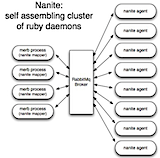 It was with much excitement that