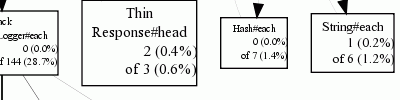
With people occasionally talking about "Code vs. Data", it only makes sense that you should be able process over code as you would a string. Sexp Path is a code processing tool that allows you to search over and process Ruby code in the form of S-Expressions.
Inspired by Git (the version control system), Delano Mandelbaum has come up with a library called Gibbler, which produces hashes and history for Ruby objects.
Why's Markaby is a really convenient bit of Ruby for generating HTML in your applications, rather than having to fiddle about with string interpolation or ERb, tangling together HTML and Ruby.
When running a Ruby daemon which executes code in a loop, if the process is killed while something is happening then problems can occur if the code doesn't handle all the exceptions properly or if the loop isn't broken cleanly. RobustThread is a Ruby class by Jared Kuolt for the creation of threads, which helps to alleviate this problem.
Anemone is a free, multi-threaded Ruby web spider framework from Chris Kite, which is useful for collecting information about websites. With Anemone you can write tasks to generate some interesting statistics on a site just by giving it the URL.
Integrity is a simple and lightweight Continuous Integration server written in Sinatra (a DSL for quickly creating web-applications in Ruby). When commits are pushed to a Git repository, Integrity builds, runs tests, and reports the build status to each team member. It supports a variety of notifiers including Email, IRC, and Twitter.
MongoDB a is a high-performance, open source, schema-free, document-oriented database written in C++. It's sort of a cross between scalable key/value stores and traditional functionality-rich relational databases.
The Interactive Ruby Shell (irb) and the Rails console are great for interacting and experimenting with your ruby application code, but sometimes it's hard to visualize the output. Gabriel Horner has come to the rescue with Hirb: a 'mini view framework' for irb which is designed to improve the default output to make it more human-readable.
Earlier this week, Rip quietly made its way into the world. It's a "next generation" Ruby packaging system, clearly meant to both work around some of the problems with RubyGems and also introduce some fresh ideas of its own. If you want to immediately jump and learn more, check out the official About us page for a tour.

 With people occasionally talking about "Code vs. Data", it only makes sense that you should be able process over code as you would a string. Sexp Path is a code processing tool that allows you to search over and process Ruby code in the form of S-Expressions.
 Inspired by
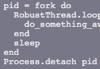 When running a Ruby daemon which executes code in a loop, if the process is killed while something is happening then problems can occur if the code doesn't handle all the exceptions properly or if the loop isn't broken cleanly.



 This post is by