Heroku Gets Add-Ons: Serious Ruby Webapp Hosting Made Easy

heroku.pngHeroku is a Ruby webapp hosting service that we first mentioned about two years ago. It started off as an online IDE of sorts, but is now a complete cloud platform for running Ruby webapps. You can develop locally and then, with a single command, deploy your app to their metered service. Well, Heroku got in touch with me last week to talk about their new "Add-Ons" feature and they've really kicked things up a notch for people wanting to quickly roll out webapps online.

Read more →

Gemcutter Is The New Official Default RubyGem Host

rubygems.pngJust two months ago we posted about Gemcutter, a new RubyGem hosting repository that, we said, was "taking aim at RubyForge and GitHub." It only took six weeks for GitHub to give up on building gems and to start recommending Gemcutter instead. Today, RubyForge is toppled also. Gemcutter developer Nick Quaranto has announced that Ruby Central has given the thumbs up to replacing http://gems.rubyforge.org/ with http://rubygems.org/ (the new Gemcutter URL) as the default gem host in RubyGems.

Read more →

21 Rack Middlewares To Turbocharge Your Ruby Webapps

rack-logo.pngIf you've worked with Web apps using Ruby, you might know of Rack, an interface that sits between Ruby applications and HTTP-speaking Web servers. All of the major Ruby frameworks and server setups use it now, including Rails. Middleware (in Rack) is code that manipulates data going back and forth between your Ruby apps and the HTTP server. You can use middleware to intercept requests, change data in mid-flow, etc. Ryan Bates has a great screencast tutorial if you're new to the concept and want to build your own.

Read more →

Muhammed Ali’s Free Ruby 1.9.x Web Servers E-Book

socket.pngEgyptian Ruby developer Muhammed Ali (of MySQLPlus fame) has released the first draft of a "Ruby 1.9.x Web Servers" booklet. It looks at how different HTTP daemons and server libraries (Thin, Passenger, WEBrick and Mongrel) perform in Ruby 1.9.1. You can read the book for free on his site or on Scribd, but if you want to download a PDF to view locally you'll need to have a free Scribd account, alas.
Read more →

What I’ve Earned and Learned From Writing A Popular(ish) Ruby Book

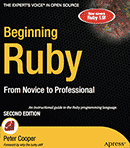
begruby-edition-2-cover.gif A few days ago I received the latest in a long line of royalty statements for my book, Beginning Ruby (as published by Apress). Long time readers might recall that Ruby Inside was started principally to promote the book, but turned into so much more that the book took a back seat. Well, the whim came over me to share the murky details of being the author of such a book, including how the royalty statements work (or not), how much is earned, sales figures, and so forth.

Read more →

7 Video Presentations From The WindyCityRails 2009 Conference

windycityrails.png The 1-day WindyCityRails conference happened again this year, this time in downtown Chicago at the Westin Hotel on September 12. Reviews were generally positive with the conference sessions balancing immediately-useful Ruby and Rails tips with related concepts like functional programming and design. All of the main track sessions were professionally recorded and are available through the official website, though I've linked to each of them individually below as well:

Read more →

Ruby Enterprise Edition 1.8.7 Released – Lower Memory Usage, Increased Speed

ruby-enterprise-edition.pngToday Phusion has announced the release of Ruby Enterprise Edition (REE) 1.8.7 (more specifically, 1.8.7-20090928). Once considered a bit of a joke, given the name, REE has proven itself to be anything but, with significant memory usage and speed improvements over the stock "MRI" Ruby implementation (achieved by way of patches to the MRI code). The key development with this release is compatibility with Ruby 1.8.7, rather than the 1.8.6 of previous versions.

Read more →