Faster Auto-Completion with Rails
Derek Haynes laments:

Derek Haynes laments:
The guys over at Fingertips present an article entitled 'excellent and pragmatic proposal for easier Unicode support in Rails'. Julian 'Julik' Tarkhanov has developed a proxy class for String that tweaks all of the methods to work properly with Unicode. You can then use code like this:

Peter Szinek has announced he's going to write a series of articles on 'screen scraping' with Ruby (more accurately, extracting data from Web pages and other online sources) and has released the first article entitled "Data Extraction for Web 2.0: Screen scraping in Ruby/Rails". He covers four basic scraping techniques, first using regular expressions, then HTree and REXML, then RubyfulSoup, and finally WWW::Mechanize. If you need to process shaky HTML sources from Ruby, read on.
KRJS is an extension to Rails views by Chew Choon Keat that helps provide a radically different mechanism for handling AJAX and RJS. He calls it "RJS without messing the views."
Aidan Finn, a freelance Ruby on Rails developer in Ireland, has developed a quick guide to creating your own generators in Rails. Code generators in Rails are useful when you have similar patterns between controller in various projects, but aren't ready to jump into creating a Rails Engine or plugin, or where such wouldn't be relevant.
The RubyExamples page is a few years old now, but I just came across a great example which still works, and which demonstrates the intense power of Ruby. Please note that Justin Bishop deserves all the credit for this one.
O'Reilly has just released "RJS Template for Rails" by Cody Fauser, the god of RJS templates. RJS templates are used in Ruby to create a full AJAX experience. They let you adjust and add elements onto the current page without reloading by using nice, clean Ruby code, without getting down and dirty with JavaScript.

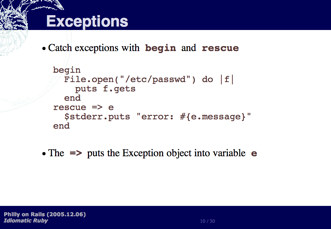
Idiomatic Ruby is an online presentation by Toby DiPasquale that goes through some of the more idiomatic features of Ruby, those that newcomers to Ruby might be confused by or overlook. It covers Modules and Mixins, Exceptions, Regular Expressions, Duck Typing, Iterators, method_missing, Continuations, Closures and Blocks, and is very concise and well put together.

Delynn Berry has developed a useful plugin called UserStamp. Whereas Rails has built in support for automatic columns such as created_at and updated_at, it doesn't (quite rightly) support concepts such as created_by, as these belong in the application domain. It's a commonly required feature though, and Delynn has done a great job of packaging it up.