Chris Wanstrath has put together an excellent guide to sessions in Ruby on Rails. He covers a whole ton of gotchas and features that I'd never known about before. Did you know that if you specify session :off in your application.rb that session can still be created automatically in certain situations? If not, check it out, there's a lot of great information.
Geoffrey Grosenbach looks at how to use memcached, a fast in-memory caching daemon, from Ruby and Rails to speed up common repeated data operations, including ActiveRecord lookups. He also includes a useful install script and patch for Mac OS X users to make memcached fly on that platform. He also demonstrates the use of the cached_model gem to significantly speed up database reads from Rails applications.
The great guys over at New Bamboo (a British Ruby on Rails development team) have launched a new blog and their first post is a tour through the testing methods available in Rails. It's ideal for those who've fallen behind with their Rails testing knowledge or those who want to get up to speed quickly.
I don't know much about Oracle, but many people have asked about Ruby's support for Oracle. One of my clients is also attempting a project with Rails and Oracle. Here are some useful resources I've found:
Many coders will reach a situation where developing a C extension makes sense, whether for doing 'heavy lifting', diving into assembly language, interfacing with other C code, etc. Luckily, developing a basic Ruby extension in C is easy.
Peter Szinek has announced he's going to write a series of articles on 'screen scraping' with Ruby (more accurately, extracting data from Web pages and other online sources) and has released the first article entitled "Data Extraction for Web 2.0: Screen scraping in Ruby/Rails". He covers four basic scraping techniques, first using regular expressions, then HTree and REXML, then RubyfulSoup, and finally WWW::Mechanize. If you need to process shaky HTML sources from Ruby, read on.
Aidan Finn, a freelance Ruby on Rails developer in Ireland, has developed a quick guide to creating your own generators in Rails. Code generators in Rails are useful when you have similar patterns between controller in various projects, but aren't ready to jump into creating a Rails Engine or plugin, or where such wouldn't be relevant.
It's not the nicest code you'll ever see, but it's a great demonstration of the power inherent in Ruby on Rails. Miklos Hollender demonstrates how he created a version of Web 2.0 app, Reddit, in under 20 minutes using Rails, scaffolding, and a little elbow grease. Source is included.
Aidan Finn has written what may be the most comprehensive walkthrough of developing an authentication system in Rails. He starts from the migrations and covers every step of the process, right through to the tests. If you want to see how a Rails developer produces an entire block of functionality from start to finish, this is worth reading.
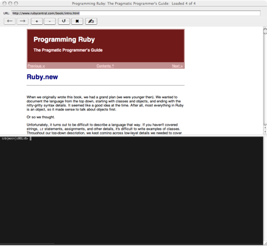
Rodney Ramdas has put together a small application called "Learn Ruby" that shows the freely available version of the Pickaxe Ruby book alongside an instance of irb, meaning you can work through the examples and tutorials more freely. Note that it's for OS X only.
A few months ago I was getting fed up of having to create new ActionMailers from scratch on my Rails applications, so I decided to come up with a 'generic' way to cover all the bases. Instead of creating multiple mailers, you create a single mailer and append generic methods. The content goes to the regular RHTML files and you send through whatever you want from your controllers. See Simplifying ActionMailer development in Ruby on Rails. There's probably a lot that could be done to it now, but it works great for me.