Raptor: A Forthcoming Ruby Web Server for Faster App Deployment


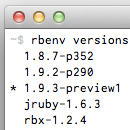 rbenv is a new lightweight Ruby version management tool built by Sam Stephenson (of 37signals and Prototype.js fame).

 Ryan Davis has announced the release of RubyGems 1.5.0. It comes just a month after the release of 1.4 which, notoriously, didn't work with Ruby 1.9.2. These problems have now all been ironed out and Ruby 1.8 and 1.9 users alike can safely upgrade (fingers crossed).
How would you like to get a full Ruby on Rails stack up on Ubuntu with one command?
 Parslet is a new "simple parser framework" for Ruby built by Kaspar Schiess. It follows the PEG (parsing expression grammar) style of parsing and its primary goals are to be simple, testable, and to have extensive and powerful error reporting features (something that Kaspar states Treetop sorely lacks).
 JetBrains (of IntelliJ IDEA fame) has today released RubyMine 3.0, the latest version of its cross-platform Ruby and Rails IDE. It follows on almost 18 months to the day from RubyMine 1.0. Back then we noted that the public reception of RubyMine was strong and JetBrains have only made it better since then.

A couple of weeks ago, I wrote about RubyDoc.info, a "good looking, up-to-date Ruby documentation" site powered by YARD. Well, as of YARD 0.6 you can get the same greatness that RubyDoc.info provides applied to your local machine's collection of gems in just a few steps. Try it out - you won't regret it.
 Pusher is a new Web service from New Bamboo that makes it easy to push data to users of your web applications "live", outside of the request response cycle. They've embraced Web Sockets technology and built a REST API to which you can post events. Its flexible channels are based on a publish/subscribe model and you can send events as JSON which communicate with all connected browsers.
 In the UK there's a cliché that goes: "You wait hours for a bus, and then three come along at once!" So it went with these three Ruby date and time libraries. They all made an appearance on RubyFlow last week and are all useful in their own ways, depending on how you're working with dates and times.
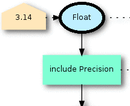 When you want to inspect your objects in Ruby,
 Object#inspect, p, or awesome_print are all valuable. You're stuck with plain-text, though, and primarily designed to look at object data rather than object models. If you want to drill down into parent classes, see object and class relationships, etc, then, check out DrX, a visual object inspector for Ruby!
 Vagrant is a Ruby-based tool for building and deploying virtualized development environments. It uses Oracle's open-source VirtualBox virtualization system along with the Chef configuration management engine along with lots of Ruby goodness to automate the creation and provisioning of virtual machines for development purposes.
 New Relic's RPM, an application performance monitoring and reporting system, has today announced it has added full support for Sinatra and Rack-based Ruby applications to its traditionally Rails-centric service. It's been possible to hack in support for non-Rails apps into New Relic before, but this move brings them officially into the fold with all of the features only Rails apps used to be able to take advantage of.
 Harmony, from Martin Aumont, is a new Ruby DSL for executing JavaScript and DOM-using code from within Ruby apps. Why's that cool? Well, it enables you to build your own Ruby-level unit tests for JavaScript code within your Web applications - everything can be under one set of test suites!
 Hammertime (GitHub repo) is a new interactive error console for Ruby by Avdi Grimm, modelled after those found in the Squeak/Smalltalk and LISP environments. It fills some of the same roles as ruby-debug, except in a less intrusive and more Ruby-esque fashion. Be warned though.. currently it's for Ruby 1.8.x only.
 Rackamole (GitHub repo) is a Rack application that lets you to monitor the interactions between users and your own Rack-based application (e.g. any Rails or Sinatra app). As well as pumping out information to the console or a log file, there's a Web interface called Wackamole to give you the skinny on your app activity.
 Amp is a new Ruby based project that aims to "change the way we approach VCS" (version control systems). Currently it's basically a port of the Mercurial version control system - a common alternative to the Git system that's more popular in Rubyland - but it aims to abstract things to the point where it could be used in place of Git, Bazaar, SVN, CVS, Darcs, and so forth.
 Have you ever yearned for something like Rails's
 script/console or Merb's merb -i in your other Rack based apps? If so, then Marcin Kulik's racksh, inspired by Heroku's console, might be for you.
 MagLev is a new(ish) Ruby implementation built by Gemstone Systems that focuses on providing an integrated object persistence layer and a distributed shared cache - a truly scalable Ruby implementation. Maglev has, however, had an air of vaporware about it, having been hyped up in early 2008 and only available to a small group of alpha testers till now. That changes today with the first public, alpha release!
 In the past two years we've seen a number of changes in the world of Ruby webapp deployment, but have you heard of Torquebox? Built upon the Red Hat Inc. JBoss middleware, Torquebox is an enterprise-grade application server that provides scale-oriented services to your Ruby webapps, including turn-key clustering. With its latest release, Torquebox supports all Rack-based Ruby frameworks.
 Jekyll is a simple Ruby-powered static site generator, originally by Tom Preston-Werner (aka mojombo) of Github fame. It's focused around blogging, but it can be configured to generate any kind of static site. (Note: Jekyll has been around for about a year - Tom originally blogged about it in November last year, so apologies if this is old news to some readers, but I've only recently discovered it!)
 Riot is a new Ruby test framework by Justin Knowlden that focuses on faster testing. Justin was frustrated with his slow running test suites, despite employing techniques such as using factories, mocks and avoiding database access. He realized that a slow-running suite makes one reluctant to run it or expand it - not good.
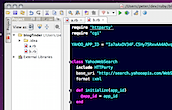 RubyMine is a Ruby and Rails IDE (for Windows, OS X, and Linux) by JetBrains, the guys behind the popular Java IDE IntelliJ IDEA. We've previously posted about how much people seem to like RubyMine, and it looks like things will get even better, as they've just released the beta of RubyMine 2.0. Notably, RubyMine 2.0 will be free to existing 1.0 users as it falls within the year allowed for free updates!
 Try Ruby was a Web site by Why The Lucky Stiff that provided a Web-based version of irb (the interactive ruby prompt) and a 15 minute tutorial for people to learn and play with Ruby. With Why's disappearance, however, the site went down and an invaluable Ruby community resource was lost.

 Ruby Version Manager GitHub repo (a.k.a. RVM) makes it ridiculously easy to install and switch between multiple Ruby versions on OS X and Linux. Over the last 24 hours, I've been playing with RVM and talking to creator Wayne E. Seguin and have been blown away with how cool (and simple) it is - you will definitely want to check this one out.
 Sometimes taking an app down for debugging purposes is just not an option. Luckily a new tool called Hijack can provide a live IRB prompt for an existing Ruby process in the same way that Erlang provides hot swapping of code (changing the definition of a system while the system is still up and running).
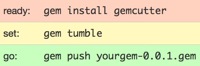 Gemcutter is a new gem hosting repository that aims to replace RubyForge as the canonical repository for gems. The project has been around for a couple of months, but Thoughtbot recently announced they're helping out with a forthcoming redesign of the site.