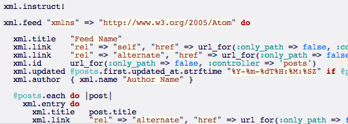
HAML is a new template language for Ruby on Rails developed by Hampton Catlin, a Canadian Rails developer. It's a high-level, heavily semantic language that breaks the mold of RHTML and makes it very hard to make markup errors. In a way similar to Python, HAML relies on indentation, which it uses to enforce DOM hierarchy.
Peter Armstrong has just released the initial version of his PDF-only book, Flexible Rails. It's available for $20, and anyone who buys the book now will get free PDF copies of every subsequent version of the first edition of the book. You can also order the book in 5 copy, 10 copy, and 30 copy editions for use in the workplace.
Chris Wanstrath has put together an excellent guide to sessions in Ruby on Rails. He covers a whole ton of gotchas and features that I'd never known about before. Did you know that if you specify session :off in your application.rb that session can still be created automatically in certain situations? If not, check it out, there's a lot of great information.
Kevin Clark presents "Things You Shouldn't Be Doing in Rails". It's not a list of things Rails isn't any good for, rather it's features or concepts related to Rails that you shouldn't be using. It covers deprecated finders, the in-built pagination classes, scaffolding, engines, layouts, and namespaced controllers.
Chris Wanstrath has created acts_as_textiled, a new plugin for Rails that allows you to specify columns on your model to be automatically parsed as Textile content.
Geoffrey Grosenbach looks at how to use memcached, a fast in-memory caching daemon, from Ruby and Rails to speed up common repeated data operations, including ActiveRecord lookups. He also includes a useful install script and patch for Mac OS X users to make memcached fly on that platform. He also demonstrates the use of the cached_model gem to significantly speed up database reads from Rails applications.
ar_mailer is a system that automatically queues outgoing mails from Rails applications (using ActionMailer) by placing them into a special database table, to then be handled by a separate process, ar_sendmail. This could be particularly ideal for systems with mass mailing applications or simply as a method to speed up certain requests in your Rails applications since only a single database write is required rather than waiting for an e-mail to finish sending.
Evan Henshaw-Plath (more commonly known as rabble) is in the process of writing a book for O'Reilly about testing and debugging Ruby on Rails applications, and has just launched a companion blog, Testing Rails. The subject of the blog is exactly what the title says, and rabble hopes to post at least one in-depth tutorial relating to Rails and testing each week. The first is Building Tests from Logs - Test Driven Debugging.
Mathew Abonyi has made available the initial release of PluginTestKit, his test kit designed to make implementing testing for plugins easy. If you're actively developing plugins and bemoaning the lack of a decent test system, check it out.
Shane Vitarana, creator of Rails Stats, has released a new plugin, acts_as_most_popular. acts_as_most_popular adds a method for each column in your model's table called most_popular_* that returns an array of the most popular entries within that column. For example, if you have 1000s of users in your user table, User.most_popular_names would return an array with the most popular names, as found in the name column. Learn more here. This seems like the sort of thing that might eventually be useful as a Calculation of some kind.
The great guys over at New Bamboo (a British Ruby on Rails development team) have launched a new blog and their first post is a tour through the testing methods available in Rails. It's ideal for those who've fallen behind with their Rails testing knowledge or those who want to get up to speed quickly.