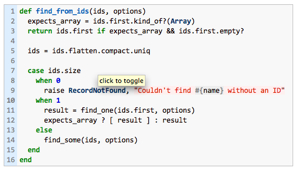
Under The Hood of Rails’ ‘find’ Method

I just came across this excellent article that provides links supporting many of the benefits of Ruby on Rails. If you need to justify your use of Ruby on Rails to employers, co-workers, or even yourself, check it out. Links about performance, scalability, philosophy and evangelism are all included.
Scott Fleckenstein has developed a plugin for Ruby on Rails called Exceptional that 'brings exception handling into the world of Rails filters'. The code speaks for itself on this one:


Softies on Rails is a popular Rails blog that looks at Ruby on Rails from the perspective of .NET developers. They've just announced that they're holding a special one-day workshop where they cover how they went from .NET to Ruby on Rails for Web development and how other .NET developers can do the same.
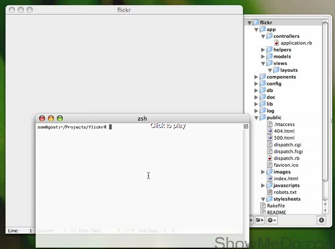
I've had this link sitting in my brew pile for some time and wanted to see if I could get it to work with the latest version of Ruby and Rails, but since I've been too busy so far, I wanted to post it anyway in case a reader would find it useful.
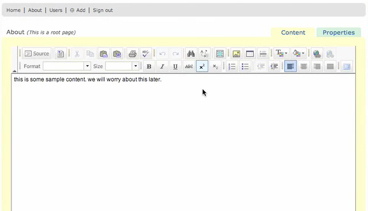
Jason Garber has got in touch about his new Rails plugin, form_test_helper, that makes testing forms easier than before. As the plugin's official home page has less information than the mail he sent me, I'm reproducing his mail in full as it's the useful reference so far:

The winners of the Rails Day have been announced. For those who haven't heard about it before, Rails Day is an annual contest in which hundreds of developers take 24 hours to develop an application.
Courtenay has come up with an ingenious solution to caching and precaching in Ruby on Rails with memcached. It caches data from database requests, as you'd expect, but you can also put together a special forking method that caches data in advance. Courtenay's suggestion for this is if a user does a search and you cache the initial page of search results, you could speculate the user might progress onto page two of the search, so you can get Rails to precache that data in advance so the next page load is blazing fast.

Austrian development agency, Sparkling Studios, look at how to use the Akismet anti-spam system to check data submitted to your site and protect your application from spam. It works by signing up for a key from Akismet and using a Ruby Akismet library. Then whenever you want to check your data, you make a simple call and Akismet returns a true or false based on whether the system believes the data to be spam.
SessionTimeout is a Rails plugin by Luke Redpath that makes enforcing short session times easy, like so:

Eric Hodel has looked at a new feature provided by Ruby 1.8.5 called Process::setrlimit. It makes it easy to limit the memory usage of your Ruby processes.. ideal if you're experiencing memory leaks! Eric shows an example that's as simple as adding this to your application's environment.rb file:
The Rails Forum has announced a Rails Tutorial contest:

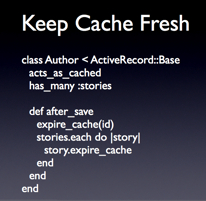
acts_as_cached is a plugin by Chris Wanstrath, Tim Myrtle, and PJ Hyett that simply allows you to cache any Ruby object in memory (using memcached). Check out the documentation for the full instructions, but if you've got a working memcached server ready and waiting, it's as easy as installing a gem (memcached-client), a plugin (acts_as_cached), and adding 'acts_as_cached' to your model.


Ryan Daigle writes about resource_feeder, a new plugin for Ruby on Rails that makes the generation of RSS and Atom feeds easy. Like so: