“CSS Form” plugin for Rails
AD.D SoftWare have developed a new plugin for Rails called cssForm that lets you create forms without tables, entirely using CSS.

AD.D SoftWare have developed a new plugin for Rails called cssForm that lets you create forms without tables, entirely using CSS.
The unstoppable Coda Hale presents an amazing article about setting up a server with Mongrel, Apache, Capistrano, SSL support, etc. for solidly serving Rails applications. An extremely well written and solid guide.
If you want to cut down on the nastier elements getting through to your Web site, filling in contact forms, and generally causing havoc, consider the rbl_check plugin by Joost.
mly from caboo.se looks at how to quickly protect certain controller actions from GET requests in Rails, and presents a couple of useful test helpers to make testing for POST vs GET compliance simple. His code lets you then do a simple test like so:

Above: Courtenay's team hard at work.
Derek Haynes laments:
The guys over at Fingertips present an article entitled 'excellent and pragmatic proposal for easier Unicode support in Rails'. Julian 'Julik' Tarkhanov has developed a proxy class for String that tweaks all of the methods to work properly with Unicode. You can then use code like this:
KRJS is an extension to Rails views by Chew Choon Keat that helps provide a radically different mechanism for handling AJAX and RJS. He calls it "RJS without messing the views."
Aidan Finn, a freelance Ruby on Rails developer in Ireland, has developed a quick guide to creating your own generators in Rails. Code generators in Rails are useful when you have similar patterns between controller in various projects, but aren't ready to jump into creating a Rails Engine or plugin, or where such wouldn't be relevant.
O'Reilly has just released "RJS Template for Rails" by Cody Fauser, the god of RJS templates. RJS templates are used in Ruby to create a full AJAX experience. They let you adjust and add elements onto the current page without reloading by using nice, clean Ruby code, without getting down and dirty with JavaScript.
Delynn Berry has developed a useful plugin called UserStamp. Whereas Rails has built in support for automatic columns such as created_at and updated_at, it doesn't (quite rightly) support concepts such as created_by, as these belong in the application domain. It's a commonly required feature though, and Delynn has done a great job of packaging it up.
Stefan Kaes takes a look at common performance problems with Ruby on Rails. He looks at:

It's not the nicest code you'll ever see, but it's a great demonstration of the power inherent in Ruby on Rails. Miklos Hollender demonstrates how he created a version of Web 2.0 app, Reddit, in under 20 minutes using Rails, scaffolding, and a little elbow grease. Source is included.
A few days ago, Courtenay of Caboose posted an article called 'pretty tables for ruby objects' that give a MySQL-command-line-client style textual view of data stored in your Rails database. The syntax worked like this:
BackgrounDRb, by Ezra Zygmuntowicz, is a system that lets you run long running tasks in the background, and not in the scope of your application. For example, you might have a Rails application that needs to send 100 e-mails, but rather than tie it to an HTTP request, you can simply pass off the job to a BackgrounDRb object and let the user know everything is proceeding as planned. There's more information here.
Coda Hale is a Rails developer from Berkeley, CA, who's developed a ton of useful plugins. I'll leave the descriptions to Coda:
One of the features of Rails 1.1 was the ability to automatically detect clients that could understand XML and send XML responses to them using the respond_to method. This also works for AJAX requests and HTML, of course. Unfortunately, though, this relies on XML and API clients sending the correct Accept headers in most cases, and, as we all know, users aren't necessarily so smart (even API users!).
Rather than use the send_file or send_data methods to send an entire, completed bulk of information back to the client, David N. Welton wanted to, effectively, print stuff to the client bit by bit. He worked out how to do it and presents his findings and sample code here.
I'm not a Windows user at all, but RForward struck me as perhaps being very interesting to those wanting to roll out Rails apps on Windows servers. It sounds like some of the new UNIX-side solutions to deploying Rails applications.. that is, proxying requests from one daemon to another rather than doing it all from one.
maiha from #caboose ran some benchmarks and produced this graph of 'requests per second' for a basic app under different dispatcher setups (Apache, lighttpd, Mongrel, etc.):
Chris Anderson looks at deploying Rails apps with Capistrano and Mongrel on Planet Argon. He provides a whole pile of recipe snippets, as well as some Capistrano recipes for Mongrel 'spinner' and 'restart' tasks.
Ryan Daigle reports that the latest 'edge Rails' has a cool new feature that lets you specify find conditions more logically. For example:
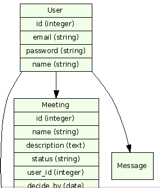
There's been talk about producing something like this in the Rails community, and it seems someone has finally done it.. a Rails Application Visualizer. Simply run a rake task and it produces a graphic showing your models and how they relate to one another. It requires the GraphViz library to run, and is only in its early days. Looks promising though!
Pagination in Rails is good, but it can lack flexibility in many situations. At that point it's time to roll your own. However, Phil Bogle and Laurel Fan came up with a solution they call paginate_by_sql that can solve some of the custom pagination problems. This needs to become a plugin.