Bruce Williams tries to solve the problem of multiple parameter types in Rails. For example, an action may accept dates via a parameter, but dates may be supplied in many forms. A 'date' parameter might arrived as if from a date_select helper, or might even be typed in directly by a user, or be pulled from a database. Rather than use before_filters to check parameters and normalize them, Bruce suggests that it should be possible to add basic conversion tools to certain data types so that all data is normalized by the time it hits your controllers.
Active Merchant is a payment processing library for Rails developed by the geniuses behind Rails powered e-commerce system, Shopify. It's under active development with support for different payment processor gateways being added regularly. So far it supports:
There are many scenarios where you might want the same controller action / method in your Rails application to perform multiple functions. For example, a wizard with multiple steps or a single form with multiple-stage AJAX calls. What you want to do is provide a 'context' to the specific request and have the controller handle that in some different way.
Action Messenger, by Trejkaz Xaoza, is a basic wrapper around Ruby's xmpp4r Jabber library that makes Jabber instant messaging services directly available to Rails applications. (Jabber is an open, XML specification and framework for instant messaging. Google Talk uses it, for example.)
Geoffrey Grosenbach introduces the RaPT Plugin Manager for Rails, the answer to the problem of slow plugin installation. Installable as a gem (gem install rapt), RaPT caches the locations of different plugins so that installation is quick and easy. Future plans include developing a central plugin repository, auto-announcement of self-developed plugins, and automatic plugin upgrading. If you want the files direct, check out the Rubyforge project site for RaPT.
You can test your controllers, your models, and, well, most of your application, but till now there hasn't been a way to explicitly test your Rails application's helpers. Now there's a solution.. the helper_test plugin (with source and instructions).
MeantimeFilter is an interesting new plugin for Rails by Roman Le Negrate. It's a little like around_filter, but rather than using a class with 'before' and 'after' methods, it uses a single method (like the other types of filter) and passes in the method to wrap 'around' as a code block. You can then yield to this or pass it into anything you like. An example:
Sending mail from Rails applications using sendmail or a normal SMTP daemon is easy, but GMail has posed some problems. Luckily, someone has worked it out and presents code on how to get ActionMailer sending through a GMail account.
I don't know much about Oracle, but many people have asked about Ruby's support for Oracle. One of my clients is also attempting a project with Rails and Oracle. Here are some useful resources I've found:
Streamlined is a framework that sits about Ruby on Rails and makes developing Rails applications even quicker than possible with scaffolding alone. It includes a ton of useful stuff like pre-built layouts, a REST layer around all the models, support for Atom, and its own DSL. As developer Justin Gehtland explains:
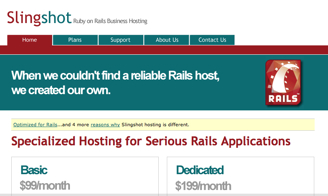
Slingshot is just one of many hosting companies getting on the Rails bandwagon. Unlike many, though, Slingshot was launched specifically with Rails in mind, as the tagline says: "When we couldn't find a reliable Rails host, we created our own." If you use the service and have any comments or a review, do post in comments here.
Railsbench, by Stefan Kaes, is a collection of scripts that makes benchmarking a Rails application quick and easy. Rather than benchmark over HTTP, Railsbench tests the 'raw' speed of your application directly, and won't include latencies involved with the network or between your HTTP daemon and Rails. If you love statistics, you'll love Railsbench. Here's some demonstration output: