Ruby5 is a new twice weekly podcast dedicated to Ruby and Rails news. It's headed by Gregg Pollack (formerly of the RailsEnvy podcast which Jason Seifer has now taken over) and Nathan Bibler. They aim to cover several bits of Ruby and Rails news in five minutes. You can also leave comments about the stories on their site as you listen. As of today, there are 7 episodes in the archives if you want to catch up, all in the 5-6 minute range.
Try Ruby was a Web site by Why The Lucky Stiff that provided a Web-based version of irb (the interactive ruby prompt) and a 15 minute tutorial for people to learn and play with Ruby. With Why's disappearance, however, the site went down and an invaluable Ruby community resource was lost.
Rails Rumble is an annual Ruby (and Rails) development contest where developers attempt to build a working web app in 48 hours. This year it took place between 22-23 August and you can now vote on the top 22 applications (as ranked by an expert panel - disclaimer: I was on the panel). Despite its name, Rails Rumble is not only for Rails applications - this year, any application that uses Rack could be entered. I wasn't aware of this before the contest took off, but hopefully with this in mind many more Sinatra and Ramaze entries could join the fold next year.
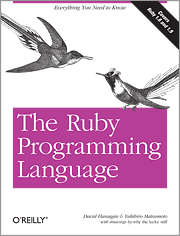
I've just had word from David Flanagan - co-author of The Ruby Programming Language, published by O'Reilly - that O'Reilly are running a temporary sale on the e-book edition. The PDF e-book is now just..$9.99 for a limited time only. That's a pretty good deal considering O'Reilly are selling the print book for $40 (though it's only $26.39 on Amazon).
Here's a list of some prominent forthcoming Ruby and Rails events scheduled through to the end of the year. Only events with tickets ready to buy right now are included - events which have already sold out are not included.
Earlier this week, Rip quietly made its way into the world. It's a "next generation" Ruby packaging system, clearly meant to both work around some of the problems with RubyGems and also introduce some fresh ideas of its own. If you want to immediately jump and learn more, check out the official About us page for a tour.
Paul Dix, of Feedzirra fame, strikes again! This time with Typhoeus (Github repo), a high-speed, parallel HTTP request library for Ruby. At first glance, you could be forgiven for wondering what the point is when we already have John Nunemaker's awesome HTTParty to build simple HTTP clients, but Typhoeus is, in many ways, like HTTParty on ten cans of Red Bull.
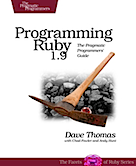
Whether you love it or not, as a Rubyist you probably have a copy of Programming Ruby (also known as The Pickaxe) floating about. It was the first English language Ruby book to be published and was instrumental in boosting Ruby's popularity in the early noughties.
Adam Sanderson has written an extremely useful RubyGems plugin called open_gem. It makes it really quick to inspect what's inside your gems, e.g.: gem open rails. You'll need to be running RubyGems 1.3.2 first.
It was way back in November 2007 that we first mentionedHeroku, the then online Rails development and app hosting environment. It's a little more than that now - it bills itself as the "instant Ruby platform" - and you can host Rails, Sinatra, Ramaze, and other Rack apps and deploy them entirely using Git.
Last week, the latest version of Ruby packaging library/tool, RubyGems, was released. Version 1.3.2 not only has a bunch of bug fixes (including supporting https URLs for gem sources) and improvements, but a number of new features. The biggest new feature is support for plugins. Plugins can be used to add commands to the gem command line tool or install/uninstall hooks. InfoQ's Mirko Stocker has put together a good summary of the new functionality along with some comments directly from RubyGems maintainer Eric Hodel.
Over on the official Ruby news site, Urabe Shyouhei has announced the release of minor updates to both Ruby 1.8.6 and 1.8.7, namely 1.8.6p368 and 1.8.7p160:
It never ceases to surprise me how many good Ruby and Rails jobs there are around, despite the economic difficulties. Okay, most of those on our jobs board are New York or San Francisco focused, but.. we have telecommuting positions listed too! So if you're looking for a Ruby job you're in the right place (for now)! We've had several positions added to the Ruby jobs board over the last month:
Five months ago JetBrains (the company behind Java IDE IntellJ IDEA) released a "public preview" of RubyMine, a new Ruby and Rails IDE. Now, they've released the beta of version 1.0, the precursor for a final 1.0 launch later this month. You can download it right away - it came in at about a 75MB download for OS X, but Windows and Linux versions are also available.
It was just several months ago that we first began to mention MacRuby on Ruby Inside, but it's been coming on by leaps and bounds since then. MacRuby is a Mac OS X-based Ruby implementation that works on the Objective C runtime. It's based on Ruby 1.9 and uses the YARV VM (as Ruby 1.9 does) but will be switching to LLVM at the next major release. MacRuby is attempting to make Ruby a first class OS X development language.
Disclaimer: Every time we've run a piece about benchmarking or performance numbers on Ruby Inside, a retraction or significant correction has come out shortly thereafter. Benchmarking is hard, ugly, and quite often wrong or biased. It is not useless, however, but if you depend on the results in any way, you should certainly try to do your own benchmarking to confirm.
2008's RubyFringe conference, put on by Canadian Rails consultancy Unspace, was heralded as a landmark in Ruby conferences and set a benchmark that has only recently been approached by the fervor around events like Ruby Manor. After the event, Unspace rapidly said that there wouldn't be another RubyFringe, but...
In late 2008, 399 Ruby developers took part in the 2008 Ruby GUI Survey, conducted by Alex Fenton. The results are now available. There's a brief summary of the results, as well as an excellent 20 page report (!!) and a separate 16 page PDF giving the per-question totals.
Can you remember what a hideous chore it was to deploy Ruby-based apps (Rails apps being a key example) before early 2008? FastCGI, proxying schemes, plain old CGI - it was all a bit of a mess. It was so bad, in fact, that in January 2008 we posted No True "mod_ruby" Is Damaging Ruby's Viability On The Web and kicked off a major discussion about it (115 comments!)
Bom dia to all of Ruby Inside's Brazilian (and Portuguese) readers! You can now, if you prefer, read (and subscribe to) the Portuguese language edition of Ruby Inside at http://www.rubyinside.com.br/(if you'd rather just subscribe to the feed, it'shere, or check it out on Twitter@rubyinside_br)

 Ruby5 is a new twice weekly podcast dedicated to Ruby and Rails news. It's headed by Gregg Pollack (formerly of the RailsEnvy podcast which Jason Seifer has now taken over) and Nathan Bibler. They aim to cover several bits of Ruby and Rails news in five minutes. You can also leave comments about the stories on their site as you listen. As of today, there are 7 episodes in the archives if you want to catch up, all in the 5-6 minute range.


 I've just had word from David Flanagan - co-author of

 A handful of random Ruby links, articles, and resources to end off the week..
 Paul Dix, of
 Whether you love it or not, as a Rubyist you probably have a copy of Programming Ruby (also known as The Pickaxe) floating about. It was the first English language Ruby book to be published and was instrumental in boosting Ruby's popularity in the early noughties.
 It was way back in November 2007 that
  Version 1.3.2 not only has a bunch of bug fixes (including supporting https URLs for gem sources) and improvements, but a number of

 It was just several months ago that we
 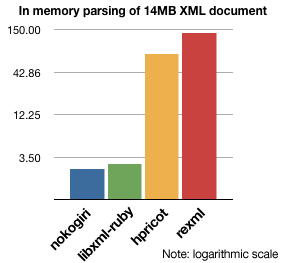 Disclaimer: Every time we've run a piece about benchmarking or performance numbers on Ruby Inside, a retraction or significant correction has come out shortly thereafter. Benchmarking is hard, ugly, and quite often wrong or biased. It is not useless, however, but if you depend on the results in any way, you should certainly try to do your own benchmarking to confirm.
 Try this:
 In late 2008, 399 Ruby developers took part in the 2008 Ruby GUI Survey, conducted by Alex Fenton. The
  Can you remember what a hideous chore it was to deploy Ruby-based apps (Rails apps being a key example) before early 2008? FastCGI, proxying schemes, plain old CGI - it was all a bit of a mess. It was so bad, in fact, that in January 2008 we posted
 2012 update: Still not up to speed with Ruby 1.9? Check out