Tom Preston-Werner has pushed out version 0.3.0 of Chronic, the popular natural language date and time parsing library for Ruby. It's a significant release because the last was 0.2.3 back in July 2007! Grab it now with gem install chronic
Back in August, Microsoft seemed to get tired of IronRuby so its project leader Jimmy Schementi jumped ship while asking the Ruby community to step up and get involved in its future. Today, Microsoft has announced new leadership for IronRuby (and IronPython) and has effectively jettisoned it into the community as a true fully open source project.
Version 1.1 is the latest release of Rubinius, a Ruby implementation based around a C++ and LLVM virtual machine but with the bytecode compiler and majority of the core written in Ruby itself. It's often called a "Ruby in Ruby." We celebrated and explained the background to Rubinius' 1.0 release 4 months ago.
Rails 3.0 has been underway for a good two years, so it’s with immense pleasure that we can declare it’s finally here. We’ve brought the work of more than 1,600 contributors together to make everything better, faster, cleaner, and more beautiful.
In April, we wrote about IronRuby hitting 1.0 and Microsoft's "3 years with Ruby [paying] off." It's sad, then, to read today that program manager Jimmy Schementi is leaving Microsoft citing a rapidly decreasing interest in dynamic languages (other than JavaScript) at the software giant.
Rubiniusor GitHub repo, an alternative Ruby implementation that's built in Ruby itself - as much as possible, has this last weekend hit the coding equivalent of a Bar Mitzvah.. its 1.0 release! Congratulations to the Rubinius team, past and present, and everyone who has helped with its release - I didn't know if you were going to make it for a moment there..
Three years after Microsoft first announced it was dipping a toe into the Ruby implementation waters, IronRuby 1.0 has been released. IronRuby is Microsoft's attempt at bringing Ruby natively to the DLR that runs on top of .NET (and Mono), and with version 1.0, it has finally reached maturity with Jimmy Schementi calling it the "first stable version."
Hot on the heels of Sinatra 1.0 comes the official release of Padrino (or GitHub repo), a webapp framework that provides an extra layer of functionality on top of Sinatra (like helpers, generators, admin interface, and internationalization). Padrino is Sinatra 1.0 compatible.
In November 2007, we casually mentioned a new Ruby webapp library called Sinatra. It took a year to capture the imagination of the Ruby community as a whole and we eventually covered it in more depth but today we're proud to (exclusively) announce that Sinatra has today reached its landmark 1.0 release!
New Relic's RPM, an application performance monitoring and reporting system, has today announced it has added full support for Sinatra and Rack-based Ruby applications to its traditionally Rails-centric service. It's been possible to hack in support for non-Rails apps into New Relic before, but this move brings them officially into the fold with all of the features only Rails apps used to be able to take advantage of.
MacRuby has hit a significant milestone in its development today: version 0.5! The key features include improved HotCocoa support (though this is now maintained separately from core on GitHub), better Ahead-Of-Time (AOT) compilation, and support for OS X 10.6's Grand Central Dispatch.
If you try to keep up with the Ruby community you're probably familiar with the Rails Envy podcast, even if you aren't subscribed. Well, it's just relaunched as.. The Ruby Show, hosted by Jason Seifer and Dan Benjamin. They plan to cover the latest Ruby related news on a weekly basis in a similar style to Rails Envy. New episodes come out each Wednesday.
It's long been a bone of contention in the Ruby world that Ruby, as a programming language, doesn't have an official spec (though RubySpec has been a noble, community effort to build an executable specification for Ruby). Now, though, there's a draft, official Ruby specification available for you to check out- based on Ruby 1.8.7 (which some aren't happy about).
Uh oh, it's upgrade time again. Today, the official Ruby 1.9 maintainer (Yuki Sonoda, a.k.a. Yugui) announced a heap overflow vulnerability in Ruby 1.9.1 and, subsequently, the release of Ruby 1.9.1-p376 (patch level 376). As the current production level release of Ruby, this is a crucial upgrade - unless you're still using Ruby 1.8.x, which isn't affected at all.
MagLev is a new(ish) Ruby implementation built by Gemstone Systems that focuses on providing an integrated object persistence layer and a distributed shared cache - a truly scalable Ruby implementation. Maglev has, however, had an air of vaporware about it, having been hyped up in early 2008 and only available to a small group of alpha testers till now. That changes today with the first public, alpha release!
MacRuby, a port of Ruby 1.9 to the Mac OS X Objective C common runtime, is today one step closer to a production-ready Ruby implementation with the release of beta 2 of MacRuby 0.5. MacRuby 0.5 has been highly anticipated since it was first mentioned back in March because it promises significant performance improvements, a new LLVM based virtual machine (replacing YARV), and significant compatibility improvements and bug fixes. Even still at this beta stage, 0.5 delivers on these promises.
Heroku is a Ruby webapp hosting service that we first mentioned about two years ago. It started off as an online IDE of sorts, but is now a complete cloud platform for running Ruby webapps. You can develop locally and then, with a single command, deploy your app to their metered service. Well, Heroku got in touch with me last week to talk about their new "Add-Ons" feature and they've really kicked things up a notch for people wanting to quickly roll out webapps online.
They've had several days to settle in, but because most of you will be reading via the RSS feed it's time to make a point to announce that... Ruby InsideandRails Insidehave both been redesigned! If you usually just read the full-text RSS feed, do come and visit the site - if only to let us know what you think.
Today Phusion has announced the release of Ruby Enterprise Edition (REE) 1.8.7 (more specifically, 1.8.7-20090928). Once considered a bit of a joke, given the name, REE has proven itself to be anything but, with significant memory usage and speed improvements over the stock "MRI" Ruby implementation (achieved by way of patches to the MRI code). The key development with this release is compatibility with Ruby 1.8.7, rather than the 1.8.6 of previous versions.
Wanted to go to JRubyConf or RubyConf this year? Tough - they're sold out already. Luckily, though, there are some interesting upcoming events that you can still get in to - some online, some in multiple cities, some held in youth centers, some in hotels, and even one on a tropical island. Whew!
Looking for a Ruby/Rails job in Texas, California, Florida, Illinois, or Texas? We might have want you want in this post. This is perhaps the most diverse set of states featured in a Ruby Inside job post - usually it's just California and New York! It seems Ruby and Rails are now finding a full-time billing in a whole new set of companies.
I've been reading the Merb Way by Foy Savas (Addison Wesley). I was a little sceptical about this book at first, because of the recent marriage of the Merb and Rails core teams and the announcement that the Merb codebase would be merged with Rails as part of the march towards Rails 3. As Yehuda Katz put it, "Merb 2 is Rails 3".

 Tom Preston-Werner has pushed out version 0.3.0 of Chronic, the popular natural language date and time parsing library for Ruby. It's a significant release because the last was 0.2.3 back in July 2007! Grab it now with gem install chronic
 Back in August,


 Following on five months after the release of the popular JRuby 1.4, the
  Three years after Microsoft first announced it was dipping a toe into the Ruby implementation waters,
  Hot on the heels of
  In November 2007, we
 If you try to keep up with the Ruby community you're probably familiar with the
  It's long been a bone of contention in the Ruby world that Ruby, as a programming language, doesn't have an official spec (though
  Uh oh, it's upgrade time again. Today, the official Ruby 1.9 maintainer (Yuki Sonoda, a.k.a. Yugui) announced


 Just two months ago
 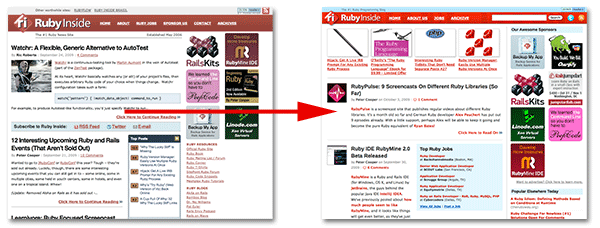 They've had several days to settle in, but because most of you will be reading via the RSS feed it's time to make a point to announce that...
  Today Phusion has
  I've been reading the