Over at the always-riveting official Ruby blog, Shota Fukumori has announced the release of Ruby 1.9.2-p290, the latest 'patchlevel' release of the current production release of Ruby MRI.
Amazon has unveiled an official Ruby SDK for AWS! Amazon.com's Amazon Web Services has been a rip-roaring success since its first publicly-available service, S3 (Simple Storage Storage), was released in 2006. It has since expanded to about 20 services in all, the most popular being S3 and the "elastic compute cloud" EC2.
Yukihiro Matsumoto, creator of Ruby and more commonly known as Matz, has joinedHeroku, the Salesforce.com-owned Ruby cloud hosting company, as its Chief Architect of Ruby.
You've given Rubinius a spin, right? And contributed code to the project? If you didn't already know, Rubinius is an 'alternative' Ruby-sorta-written-in-Ruby implementation that's production ready and has been going from strength to strength recently (I post about it quite a bit). And whatever your answers to those questions, the Rubinius team are kicking things up a notch by bribing you to get involved!
Ruby on Rails' creator David Heinemeier Hansson is currently at RailsConf 2011 along with hundreds of other Ruby and Rails developers. In a first for RailsConf, there's a live stream of some of the event which is was embedded below so you could watch DHH's keynote.
Guess what? Yep, the forthcoming Rails 3.1 is going to be bringing in a few new friends as dependencies: CoffeeScript, jQuery, and Sass. What does this mean? Why has this been controversial? I'm going to quickly run through the details here.
As an outspoken and opinionated guy, David Heinemeier Hansson (a.k.a. DHH), creator of Rails, is no stranger to a little bit of controversy. He frequently sets off interesting debates on Twitter from his @dhh account. The latest is, perhaps, the most involved yet and has been rattling on for a couple of hours today.
It's a newsflash! JRuby 1.6.0 has been released today. Congratulations to the JRuby team. 1.6 is a significant and much awaited release and comes after a 9 month push of over 2500 commits.
It's been a dies horribilis for MRI Ruby today with two new security vulnerabilities forcing the release of 3 new recommended production versions of the de facto official Ruby interpreter. The first, a vulnerability in FileUtils.remove_entry_secure affects both 1.8 and 1.9 branches, while the second, a $SAFE mode vulnerability, affects only 1.8.
Ryan Davis has announced the release of RubyGems 1.5.0. It comes just a month after the release of 1.4 which, notoriously, didn't work with Ruby 1.9.2. These problems have now all been ironed out and Ruby 1.8 and 1.9 users alike can safely upgrade (fingers crossed).
Clever Algorithms is a newly released book by Jason Brownlee PhD that describes 45 algorithms from the Artificial Intelligence (AI) field with Ruby-based examples. It's well produced and, notably, free in its PDF and online formats. A print copy is available at a small cost.
RailsInstaller is a new project from Wayne E Seguin (of RVM fame) that brings RubyInstaller-style simplicity to getting Ruby and Rails set up on Microsoft Windows (XP, Vista, or 7). In a single wizard-driven installation you get Ruby 1.8.7-p330 (with DevKit), Rails 3.0.3, Git, and SQLite 3.
The JRuby team has announced the release of JRuby 1.6.0 Release Candidate 1. The final release is still a little way off but the bulk of the work is in place. It's billed as the "largest release of JRuby to date" which, given how awesome 1.5 was, is a big deal, especially as it adds initial Ruby 1.9.2 language and standard library compatibility (though 1.8.7 is still the "default").
You may imagine that the ruby-core mailing list is a 24/7 programming disco dealing with core Ruby implementation topics.. but no, it's usually a low-traffic list with calm discussion of bugs and patches. This week, however, some Interesting Stuff™ has happened and the kimono has been lifted on a few issues including, notably, a potential Ruby 1.8.8.
Starting January 10, 2011 (just one week after this post), I'll be teaching an online Ruby course with CodeLesson.com - me being Peter Cooper, author of Beginning Ruby. It lasts 4 weeks and will cover most things a new Ruby developer (or programmer in general) needs to know to become a confident, intermediate-level Rubyist. It's a great springboard from which to move on to Rails or other more advanced Ruby topics.
Christmas is a special time for Rubyists and not only for those of us taking the opportunity to get drunk and eat a lot. December 25 has been a popular release date since Ruby 1.0 was released on December 25, 1996 and several developers were preparing releases of their libraries and Ruby implementations this year too. So what December 25, 2010 bring?
Three months on from the 1.1 release, Rubinius 1.2 has hit the streets bringing together 242 commits from 10 developers. As well as the typical bugfixes and performance tweaks that come with any implementation update, 1.2 brings some underlying structural changes that set up the path to getting better Windows support, Ruby 1.9 support, and the removal of the much-loathed GIL (Global Interpreter Lock) in future releases.
As 2010 comes to a close, I've dug through Ruby Inside archives to remind myself how far the Ruby scene has progressed over the year. Over the past couple of years, it's been hinted that the pace of developments in the Ruby world is slowing down, but nothing could have been further from the truth in 2010 (well, except in September..)
Ruby screencasting supremo Geoffrey Grosenbach has unveiled PeepCode's new Meet Rails 3 series. There are two parts so far, clocking in at 75 and 92 minutes respectively - they're $12 each or "free" if you have a PeepCode Unlimited subscription.
TechCrunch reports that Salesforce.com is to acquire the popular Heroku Ruby app hosting service for approximately $212 million in cash. We first posted about Heroku back in November 2007 (18 months before it even went commercial) and since then they've gone from strength to strength. Congratulations to the team!
Many infrastructure companies have recently adopted a drip-feed pricing model - consider renting servers from Amazon EC2 or monitoring our servers with New Relic RPM. The cloud database industry is still in its infant stages but today Salesforce.com has kicked things up a notch in offering all of its enterprise-scale database technology in a new cloud database service, Database.com.
JetBrains (of IntelliJ IDEA fame) has today released RubyMine 3.0, the latest version of its cross-platform Ruby and Rails IDE. It follows on almost 18 months to the day from RubyMine 1.0. Back then we noted that the public reception of RubyMine was strong and JetBrains have only made it better since then.
Rails for Zombies is an intriguing attempt to teach people how to use Ruby on Rails directly in the Web browser. It comes from Envy Labs (and specifically Gregg Pollack, once of RailsEnvy fame).
AppSumo is an intriguing "bad ass developer bundle" that brings together $1543 of credit for ten different Web app development related resources (most are Ruby focused or have Ruby APIs) for a mere $47 purchase.
If you've been following the Ruby scene for a while you'll have heard of Gregory Brown. He's the author of O'Reilly's Ruby Best Practices, creator of the Prawn PDF library, and the head honcho of the Ruby Mendicant University. He does a lot of community funded Ruby work and his latest attempt to help fund his work is Practicing Ruby, an e-mail newsletter and discussion group dedicated to helping intermediate Rubyists to sharpen their skills.
Heroku, a popular Ruby webapp hosting platform that's picked up $13m in funding, has today unveiled their new Facebook App package. The package is aimed squarely at people wanting to develop Facebook apps and brings together several of Heroku's main offerings in a single, discounted monthly package.

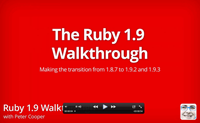 In a presentation about Ruby 1.9.3, Yuki Sonoda notes that Ruby 1.8 has "no future" and its "end of life" is being discussed pretty seriously. Ruby 1.8 is becoming history, but what's the alternative? Why, Ruby 1.9! :-)
 Over on the
  Over at the always-riveting official Ruby blog, Shota Fukumori
  Amazon has unveiled
 You've given
  Ruby on Rails' creator David Heinemeier Hansson is currently at
  Guess what? Yep, the forthcoming Rails 3.1 is going to be bringing in a few new friends as dependencies:
  It's a newsflash!
  It's been a dies horribilis for MRI Ruby today with two new security vulnerabilities forcing the release of 3 new recommended production versions of the de facto official Ruby interpreter. The first, a vulnerability in
  Ryan Davis has

 The JRuby team has
  You may imagine that
  Starting January 10, 2011 (just one week after this post), I'll be teaching an
 Christmas is a special time for Rubyists and not only for those of us taking the opportunity to get drunk and eat a lot. December 25 has been a popular release date since Ruby 1.0 was released on December 25, 1996 and several developers were preparing releases of their libraries and Ruby implementations this year too. So what December 25, 2010 bring?
 Three months on from the 1.1 release,
  As 2010 comes to a close, I've dug through Ruby Inside archives to remind myself how far the Ruby scene has progressed over the year. Over the past couple of years, it's been hinted that the pace of developments in the Ruby world is slowing down, but nothing could have been further from the truth in 2010 (well, except in September..)
 MacRuby team lead and Apple employee Laurent Sansonetti has
  Ruby screencasting supremo Geoffrey Grosenbach has unveiled PeepCode's new
  TechCrunch
  Many infrastructure companies have recently adopted a drip-feed pricing model - consider renting servers from Amazon EC2 or monitoring our servers with New Relic RPM. The cloud database industry is still in its infant stages but today Salesforce.com has kicked things up a notch in offering all of its enterprise-scale database technology in a new cloud database service,
  JetBrains (of IntelliJ IDEA fame) has today released

 Heroku, a popular Ruby webapp hosting platform that's picked up $13m in funding, has today unveiled their new