At RailsConf 2009 (of which a summary will be coming soon to Ruby Inside), Hongli Lai and Ninh Bui of Phusion (the guys behind Passenger) gave a presentation called Scaling Rails. As part of this, they wanted to demonstrate that Ruby is powerful enough to run a 3D game at a decent speed so they built Rubystein, a Wolfenstein 3D clone in Ruby, using the Gosu game development library.
It's been just over a year since the last Interesting Ruby Tidbits That Don’t Need Separate Posts post (number 21, specifically). I think I felt that RubyFlow filled the gap for quick-fire group posts, but.. it doesn't, quite (even though it's going great guns!) There are still a lot of awesome things out there that should be highlighted here but that, perhaps, don't need their own post. So.. the series is back.
It never ceases to surprise me how many good Ruby and Rails jobs there are around, despite the economic difficulties. Okay, most of those on our jobs board are New York or San Francisco focused, but.. we have telecommuting positions listed too! So if you're looking for a Ruby job you're in the right place (for now)! We've had several positions added to the Ruby jobs board over the last month:
When it comes to developing large systems with many interdependent parts, it’s common nowadays to use “queues.” A queue is, for the most part, just a list that you can add items to and remove items from. Apps can use queues to despatch jobs / tasks to other apps or to shuttle logs and status information around.
It was just several months ago that we first began to mention MacRuby on Ruby Inside, but it's been coming on by leaps and bounds since then. MacRuby is a Mac OS X-based Ruby implementation that works on the Objective C runtime. It's based on Ruby 1.9 and uses the YARV VM (as Ruby 1.9 does) but will be switching to LLVM at the next major release. MacRuby is attempting to make Ruby a first class OS X development language.
Twitter - the lifestreaming-meets-microblogging social site - has exploded in the last year and lots of applications have been developed that can take advantage of Twitter accounts. The downside is that many have required users to put their own Twitter username and password credentials into the third party apps.. a security minefield!
If you're a Ruby developer, the current recession needn't be too hard.. depending on where you live, of course. There are some good jobs going out there and if you're on the hunt for one, we've recently had several Rails-focused positions come by our Ruby jobs board in both the US and UK:
Dash, a new metrics service from FiveRuns, has been moved to private beta (for which you can apply) allowing interested developers to take part in assessing a new way to monitor your applications. The new service from FiveRuns is an extensible monitoring service for gathering metrics from your critical daemons and applications.
Heist is a Scheme interpreter by James Coglan written in Ruby. Scheme is a programming language that's a dialect of Lisp, was an influence upon Ruby, and still a popular choice for learning functional programming (such as in the classic Structure and Interpretation of Computer Programs).
Looking for a job where you can work on Ruby and Rails apps? You're in the right place! Recently we've had several Rails-focused positions added to the Ruby jobs board.
Managing and organizing multiple JavaScript files in your Rails applications can be a real pain, especially when it comes to deploying your application and you need to minimize those JavaScript files down for better application performance.
It's time to thank those great companies and individuals who help keep Ruby Inside (and often other Ruby sites) going. Note: All descriptions and notes are written by Ruby Inside and are not directly influenced by the sponsors. As such, any opinions stated are those of Ruby Inside and not necessarily shared by the sponsor!
Rhodes - developed by Rhomobile - is an intriguing framework of Ruby interpreters that can be used to develop native applications for the iPhone, Windows Mobile, RIM (Blackberry) and Symbian smartphone platforms (with Android support to come). Last month, Werner Schuster (of InfoQ) wrote a basic roundup of how Rhodes works.
The development team behind the time tracking site freckle, have just released a PDF guide detailing the terminology and processes behind processing credit card details in Ruby.
Looking for a job where you can work on Ruby and Rails apps? You're in the right place! Recently we've had several Rails-focused positions added to the Ruby jobs board. Alternatively, if you're a company looking to hire Ruby and Rails developers and you're in the US, head over to the job board too - it costs $150 for 60 days of exposure, and your jobs get featured in a post like this too!
Berkeley DB is a high performance database system initially developed in the early 1990s. It's not an SQL driven database engine - it just stores data in key/value pairs - but BDB is very fast, available to use on most operating systems, and is dual licensed for open source and commercial use. It has several benefits to just using a flat file or a PStore: transactions, fine-grained locking, replication, and hot backups, for starters.
Everyone's favorite Australian Ruby developer, Dr. Nic Williams, has put together a handy slide presentation called How to Package Your Ruby Code where he demonstrates how he packages his various bits of Ruby code using RubyGems. His process is backed by his own NewGem, a library that generates a framework for a new Ruby gem, and Hoe by Ryan Davis.
It's time to thank those great companies and individuals who help keep Ruby Inside (and often other Ruby sites) going. Note: All descriptions and notes are written by Ruby Inside and are not directly influenced by the sponsors. As such, any opinions stated are those of Ruby Inside and not necessarily shared by the sponsor!
Back in March, Ruby developer Gregory Brown raised the idea of receiving donations so he could work on open source Ruby projects full-time. It went well, and out of this project came Prawn, a pure Ruby PDF generation library. Not one to rest on his laurels, Gregory's now working on a book for O'Reilly called Ruby Best Practices, billed as "for programmers who want to use Ruby the way Rubyists do." The book will cover how to design "beautiful" APIs and DSLs, along with lots of other general topics that will make your code more expressive and make you a better Ruby developer into the bargain.
Anyone building up a project with many dependencies - and in the Ruby community, with so much functionality wrapped up in gems and plugins, it's hard to imagine not having external dependencies! - must face the issue of managing the situation in source code control. How do you maintain everything you need in your own repository, while still being able to update your dependencies from their own repository? How do you set things up so you can even contribute to the projects you depend on?
Giles Bowkett is anything but a quiet chap - indeed, he's one of the more outspoken members of our community. With the roar, however, comes a lot of wisdom, and Giles recent work on integrating Ruby and MIDI is inspired.

 At
At 
 It's been just over a year since
  When it comes to developing large systems with many interdependent parts, it’s common nowadays to use “queues.” A queue is, for the most part, just a list that you can add items to and remove items from. Apps can use queues to despatch jobs / tasks to other apps or to shuttle logs and status information around.
 It was just several months ago that we








 Everyone's favorite Australian Ruby developer, Dr. Nic Williams, has put together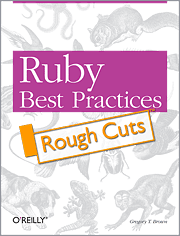
 Anyone building up a project with many dependencies - and in the Ruby community, with so much functionality wrapped up in gems and plugins, it's hard to imagine not having external dependencies! - must face the issue of managing the situation in source code control. How do you maintain everything you need in your own repository, while still being able to update your dependencies from their own repository? How do you set things up so you can even contribute to the projects you depend on?