Clojure, from a Ruby perspective
Fogus' recent article "clojure.rb" speculates about why there seem to be so many Ruby users adopting Clojure. As a Ruby user who adopted Clojure, I figured I'd write about my experiences.

Fogus' recent article "clojure.rb" speculates about why there seem to be so many Ruby users adopting Clojure. As a Ruby user who adopted Clojure, I figured I'd write about my experiences.
Tonight, Ruby Inside has changed for the better. If you're reading on the Web, it will be immediately apparent, but if you're reading via the feed, check out RubyInside.com. Ruby Inside is no longer a magazine-style blog - it's a Daring Fireball-style tumblelog.

Being as though we’re all html escaping everything these days, why not make it faster?
I'm pleased to announce that we released DataMapper 1.0 "Vermouth" earlier today.
 Need a new Ruby or Rails job? They're getting posted daily on jobs.rubynow.com but we've got 8 special ones of our own that have come in via the Ruby Inside jobs board. Jobs this month come from the United Kingdom and the US and, as is proving typical, are Rails heavy.
 Nestful is a simple HTTP/REST client library for Ruby, developed by Alex MacCaw (of Juggernaut) fame. Nestful allows you to consume basic Web services easily, usually in a single line of code. It can deal with JSON, buffered downloads, and callbacks out of the box.
 Coderpath is a weekly podcast by Ruby developers Miles Forrest and Curtis McHale where they typically interview a different Ruby developer and discuss some of their current work. Most of the episodes are in an interview format and guests so far include a handful of Ruby developers you'll know (such as DHH and Ryan Bates).
With Microsoft's IronRuby and Silverlight, Ruby can become a first-class citizen in the browser on Windows, Linux and OS X.. think <script type="text/ruby"> - yes, it's possible! This walkthrough will get you started with using Ruby in the browser for HTML and vector-graphics-based applications. IronRuby enables Web developers to use Ruby to write client-side browser applications and even reuse code between the server and the client.
 MessagePack GitHub repo is a new binary-based object serialization protocol and library built with efficiency and speed in mind. Developer Sadayuki Furuhashi presents it as a faster alternative to JSON that has similarly broad support across several popular languages.
 RubyFlow is Ruby Inside's community driven sister site where you can post cool Ruby links you want to share (even of your own stuff). With 20–80 posts each week, there's too much to cover on Ruby Inside, but I want to provide a regular roundup of the "best of" RubyFlow. This instalment covers early March — enjoy!
 JRuby is undoubtedly the most mature of the alternative Ruby implementations. Supporting Ruby 1.8.7 and 1.9.1 (mostly!) and JIT compilation, JRuby is already in use in mission critical Ruby apps and runs scarily fast on the JVM. In this interview with JRuby core member, Charles Nutter, we dig deep into what makes JRuby tick.
Looking for a Ruby or Rails job? There are still some good ones out there. They're getting posted daily on jobs.rubynow.com but we've got 6 special ones of our own that have come in via the Ruby Inside jobs board. Jobs this month come from the United Kingdom and the US (Portland, Chicago, Birmingham and Santa Barbara) and are, as usual, Rails heavy.
 Cramp (GitHub repo)is a new, asychronous evented Web app framework by Pratik Naik of 37signals (and the Rails core team). It's built around Ruby's EventMachine library and was designed to use event-driven I/O throughout - making it ideal for situations where you need to handle a large number of open connections (such as Comet systems or streaming APIs.)
 I love checking out new Ruby libraries, and recently many new ones have passed my eyes. The most prominent releases get their own post on Ruby Inside, but often there are less significant libraries that I'd struggle to write 100 words about yet still contribute to Ruby's lifeblood. This post aims to round up a selection of my recent discoveries.
 Much of Merb's momentum has been merged into Rails 3, but one-time Engine Yard developer Daniel Neighman has found himself moving in a new direction, inspired by what they had once achieved with Merb Slices. Since then, he's taken fully-mountable Rack applications to the extreme in creating Pancake, a tool & framework to let you stack and loosely couple Rack-based webapps.
 Rango is a Rack-based lightweight Web framework by Jakub Šťastný that has seemingly borrowed a little bit less from past Ruby frameworks and a bit more from Django. Based on the 1.9 version of Ruby, Rango works with rvm, Rip, Usher, Warden, and both the new Gem bundler and the venerable DataMapper by default.
 Have you ever yearned for something like Rails's
 script/console or Merb's merb -i in your other Rack based apps? If so, then Marcin Kulik's racksh, inspired by Heroku's console, might be for you.
Looking for a Ruby or Rails job in this economy? They're still there! They seem to be getting posted daily on jobs.rubynow.com but we've got 5 of our own that have come in via the Ruby Inside jobs board.
 Welcome to the latest installment in the series of compilation posts summarizing some of my latest findings in the world of all things Ruby. Let's tackle those links..
 Jekyll is a simple Ruby-powered static site generator, originally by Tom Preston-Werner (aka mojombo) of Github fame. It's focused around blogging, but it can be configured to generate any kind of static site. (Note: Jekyll has been around for about a year - Tom originally blogged about it in November last year, so apologies if this is old news to some readers, but I've only recently discovered it!)
 Riot is a new Ruby test framework by Justin Knowlden that focuses on faster testing. Justin was frustrated with his slow running test suites, despite employing techniques such as using factories, mocks and avoiding database access. He realized that a slow-running suite makes one reluctant to run it or expand it - not good.
 Mustache is a new templating library from Chris Wanstrath (a.k.a. defunkt of GitHub fame) that provides a way to render views in your chosen Ruby web framework. Influenced by ctemplate, Mustache helps to keep your MVC layers separate by actively preventing the inclusion of application logic in your views.
 Watchr is a continuous-testing tool by Martin Aumont in the vein of Autotest (part of the ZenTest package).
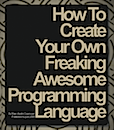 Create Your Own Programming Language is a interesting new information product and community by Marc-André Cournoyer (of Thin fame) that promises to teach you how to create a simple programming language. The official site is well worth checking out, even if you don't want to buy it, as it's a great example of how to sell a product like this. Create Your Own Programming Language costs $39.99 and has a two month money back guarantee.
 Evan Light has recently pushed his Coulda project to Github - it's a test framework based on Test::Unit, inspired by Cucumber, Shoulda and Thor.
 Welcome to the latest in the series of random Ruby related links I've picked up over the past few weeks. It's a crazy grab-bag of links this time around! Whatever your job, interest, or fetish, there's bound to be something in here that tickles your fancy if you're a Rubyist. Enjoy!
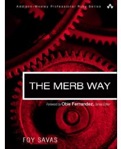 I've been reading the Merb Way by Foy Savas (Addison Wesley). I was a little sceptical about this book at first, because of the recent marriage of the Merb and Rails core teams and the announcement that the Merb codebase would be merged with Rails as part of the march towards Rails 3. As Yehuda Katz put it, "Merb 2 is Rails 3".
 Sick of Rails 3.0 yet or still enjoying your