RubyConf 2011 Registration Open (But For How Long?)


 Ruby Inside wouldn't be what it is without you but it's time for me to thank the companies who also help to keep Ruby Inside going by sponsoring my work. Thanks!
 Messaging in the context of application architecture (grandly referred to as message oriented middleware on Wikipedia) is similar to messaging in the real world. If you want to ask your colleague to do something, you'll send him a message of some sort. And if your app needs to ask another app to do something it can do the same, send a message to another app or process to run a command or send an e-mail, for example.
 A few days ago I told the story of ruby-head (MRI) getting 36% faster loading, perfect for tackling those file-heavy Rails 3 apps. Awesome for Ruby 1.9.3 but not so good for us now, right? Todd Fisher to the rescue! He's created a patch backporting the performance tweak to Ruby 1.9.2-p180.
 Xavier Shay is an Australian Rubyist who shares an issue with most of us: slow loading Rails 3 apps on Ruby 1.9.2! Unlike most of us, he put together a solution for ruby-head (what I'm calling 1.9.3 but isn't technically*) that, in my own tests, slashed 37% off the boot time of my Rails 3.0 app. He shared his work just a week ago. Awesome! But some other developments have occurred since..
 The topic of 'hiring' always generates a lot of discussion. And why not? Talking about hiring is a convenient way to pass judgment on large groups of people while keeping a professional, detached demeanor.. Ouch! But the topic has enough technical basis to warrant the interest of experienced developers, so here we are.
 Just over 3 years ago in May 2008, I wrote about New Relic for the first time. Since then they've grown rapidly and dominate the Ruby and Rails application monitoring scene with their RPM service. Today, they've made some major tweaks..
 Today there are *drumroll* 18 new jobs to share from the Ruby Jobs board from companies like Expedia, Brightbox (the British Rails hosting guys) and LivingSocial.

 I started Ruby Inside in May 2006 as a promotional vehicle for my then in-progress book, Beginning Ruby. It eventually went on to be published by Apress and is now on its second edition having sold quite a few copies.
 MacRuby's lead developer and Apple employee Laurent Sansonetti has today released MacRuby 0.10 (yep, that's ten), the latest version of the Mac OS X-focused Ruby implementation. 0.10 is the latest stepping stone on the way to a forthcoming 1.0 release.
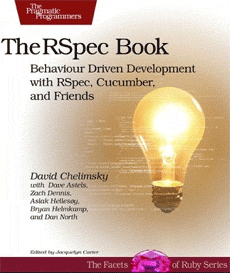 The RSpec Book (Amazon.com) by David Chelimsky (plus a cadre of BDD superstars) is a recent release from The Pragmatic Programmers and a handy addition to any TDD-mad or RSpec-using developer's bookshelf. You can buy a copy from Amazon.com, Amazon.co.uk, or direct from the publisher (more expensive but a PDF version is available).
 It's been a killer month for new Ruby and Rails jobs over at the Ruby Inside Jobs board so I'm going to cut the filler to a minimum today.. though if you want to learn more about posting one of your own, check our Post A Job page. The current bonus is you'll get your job ad into the 4000+ subscriber-strong Ruby Weekly for free!
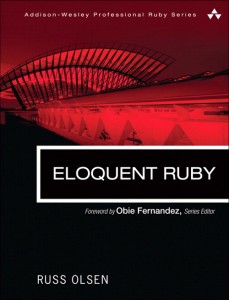 Eloquent Ruby (Amazon.com - print & Kindle) by Russ Olsen is the first Ruby book I've read in its entirety within 24 hours; it's that good. That may be all you need to know before you buy a copy at Amazon.com, Amazon.co.uk or read it on Safari (if you have an account). If you want to learn more though, keep reading.
Yes, I'm sad enough to have had this in my calendar for some time but.. it's Ruby's 18th "birthday" today! Happy Birthday Ruby! While this means it can drink, vote, and otherwise join its slightly older friends Perl (24) and Python (21) in the nightclubs of Europe, I was surprised to learn that coming of age in Japan is at 20 years old.
It's time for us to thank the companies who help to keep Ruby Inside going by kindly sponsoring our work. So.. thank you! (And thank you for reading too, naturally.)
 You may imagine that the ruby-core mailing list is a 24/7 programming disco dealing with core Ruby implementation topics.. but no, it's usually a low-traffic list with calm discussion of bugs and patches. This week, however, some Interesting Stuff™ has happened and the kimono has been lifted on a few issues including, notably, a potential Ruby 1.8.8.
 It looks like California's the place to be if you're a Rubyist or Rails developer looking for a full-time position right now. 6 of today's 9 positions are in California with 5 of those in the Bay Area. Elsewhere, there are also positions in Texas, Illinois, and the UK. Good luck!
 The Rails 3 Way is the much awaited, Rails 3-focused followup to The Rails Way, a popular Rails book (and, dare I say, bible) by Obie Fernandez. It features forewords by David Heinemeier Hansson and Yehuda Katz and checks in at a desk-thumping 759 pages of full-on Rails 3 goodness (despite the book sites claiming 850 pages). I've given it the once-over.
 Been missing esteemed rapper and author Coolio (real name Tony Arcieri) recently? He's been busy studying Ruby and building Cool.io (or GitHub repo), a Node.js and Sinatra inspired "event framework" for Ruby powered by libev. Think EventMachine but with a cuter, Sinatra-style API. cool.io isn't exactly new, though, it's a rewrite-meets-rebrand of Rev (which started life back in 2007).
 As 2010 comes to a close, I've dug through Ruby Inside archives to remind myself how far the Ruby scene has progressed over the year. Over the past couple of years, it's been hinted that the pace of developments in the Ruby world is slowing down, but nothing could have been further from the truth in 2010 (well, except in September..)
James Golick, a prolific Canadian Rubyist, has declared war on Net:HTTP's default of not checking the validity of the certificate sent by an HTTP server when making HTTPS requests. His new always_verify_ssl_certificates gem forces Net::HTTP to verify SSL certificates and doesn't allow other libraries to override this setting.
It's time for us to thank the companies who help keep Ruby Inside going by kindly sponsoring our work in return for a little community love. Luckily, they're all interesting in their own right and have some worthwhile products to check out - no CashForGold or dating sites here!
Automatic text summarization is the technique where a computer program summarizes a document. A text is put into the computer and a highlighted (summarized) text is returned. The Open Text Summarizer is an open source tool for summarizing texts. The program reads a text and decides which sentences are important and which are not.
 Significant and serious improvements to the core Ruby language come along as infrequently as TextMate updates. Given that TextMate has had an update recently, an important new Ruby feature was sure to be just around the corner and it is: refinements! Shugo Maeda (who works with Matz and developer of mod_ruby) presented the idea at RubyConf 2010 last month.
 Ever used Dropbox? It's awesome. A cross-platform (Windows, Mac, Linux, and even mobile) file syncing and backup service with 2GB for free (or 2.25GB if you sign up with this link). Well, if you'd like to roll out your own system on your own infrastructure, send some thanks to Ryan LeFevre, the creator of RubyDrop, an open source Dropbox clone based on Ruby and git.
 In The Ruby Stdlib is a Ghetto, Mike Perham argues that Ruby's "standard library" (all the libraries that come by default with Ruby installs) is old and crufty and suggests some parts that should be removed.
 AppSumo is an intriguing "bad ass developer bundle" that brings together $1543 of credit for ten different Web app development related resources (most are Ruby focused or have Ruby APIs) for a mere $47 purchase.