Jon Maddox was inspired by Ruby Inside's previous post about init.d startup scripts, and has put together a UNIX init.d script that can start, stop, and restart all of your Rails apps' Mongrel clusters automatically. The benefit of Jon's approach is that unlike with the startup script supplied with Mongrel, you don't need to manually copy in each Mongrel configuration file to make it work. Instead, you tell the script under which folder your apps are hosted, and it looks for your Mongrel cluster configuration files automatically. This is an ideal script if you have multiple Rails apps on a single machine and want to stop and start the entire set at once.
It's not a common pursuit but some developers would like to look through the source code to Ruby itself. It's a great way to start if you ultimately want to get involved with helping develop Ruby itself, but it's heavy stuff. Mauricio Fernandez, however, has put together a brief guide to the different source files you should read relating to different elements of functionality within Ruby. Experts only.
Most init.d start-up scripts seem to be bash scripts, but you can write them with any language. Here's some template code I use to create my own Linux services. You can even add them to chkconfig to be started properly on startup, and they'll also work with RedHat / CentOS's service system straight off.
Prolific PuneRuby blogger Satish Talim has just begun a course of free Ruby lessons. They're open to anyone who wants to get involved, and so far 43 people are signed up! The lessons have already begun, but you can still get in on the action. The syllabus is available to check out, and to register to receive the lessons you only have to e-mail Satish at satish.talim /at gmail.com. This might be an ideal chance to get those friends who keep asking you questions about Ruby off your back ;-)
Today I read JesusPhreak's "Of snakes and rubies; Or why I chose Python over Ruby" and it highlighted a few of the feelings that have been running around in my head lately regarding Ruby. He points out Python's wealth and depth of libraries, style guides, and how Python is wider used and less dependent on a single technology to promote it. While Rails is good, he seems to feel that Rails is defining the entire Ruby experience too much. I'm inclined to, sadly, agree.
Ruby Inside is running a $100 contest for people who write a Ruby or Rails related article, resource post, or tutorial this week. There's still just over 24 hours left to run so get your entries in quickly if you want a chance at winning the $100. So far there have been 16 entries and they're all pretty good. But.. there are only two entries for the second prize so far, so if you want some great odds at winning the $15 second prize, link to the contest and let us know about it!
RubyForIIS is a package that helps you set up the bindings between Ruby, Rails, and Microsoft's IIS server system. Project founder, Boris Leenaars, says:
Action Messenger, by Trejkaz Xaoza, is a basic wrapper around Ruby's xmpp4r Jabber library that makes Jabber instant messaging services directly available to Rails applications. (Jabber is an open, XML specification and framework for instant messaging. Google Talk uses it, for example.)
Ruby legend whytheluckystuff has developed a new HTML parser called Hpricot. It's easy to install and use and parses HTML in a liberal fashion. It does, however, require a compiler to install (as it's written in C), so should be okay on Linux and Mac OS X, though not necessarily on Windows (yet).
TeensyMud is a simple MUD (multi-user dungeon - a bit like a text adventure) server written in Ruby. It's not particularly complex, but it has a great structure and there's a lot to learn from looking at the code (patterns are well used). It's also ripe for extending and for building, perhaps, a proper game or full multi-user environment on.
I don't know much about Oracle, but many people have asked about Ruby's support for Oracle. One of my clients is also attempting a project with Rails and Oracle. Here are some useful resources I've found:
Cobra vs Mongoose is a Ruby library by Paul Battley that makes it easy to convert between XML and Ruby hashes (in both directions). It's a good alternative to YAML or JSON. It's available as a gem with gem install -r cobravsmongoose. Here's some demonstration code:
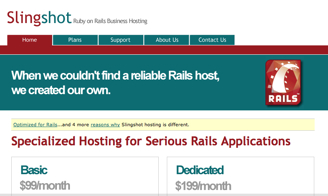
Slingshot is just one of many hosting companies getting on the Rails bandwagon. Unlike many, though, Slingshot was launched specifically with Rails in mind, as the tagline says: "When we couldn't find a reliable Rails host, we created our own." If you use the service and have any comments or a review, do post in comments here.