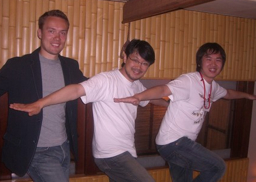
Interview with Francois Lamontagne, the “Ruby Fleebie”



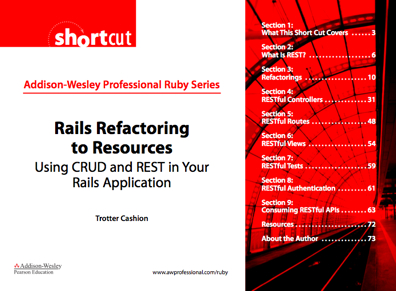
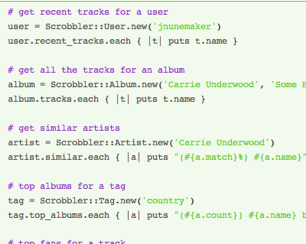
 Joyent Slingshot allows developers to deploy Rails applications that work the same online and offline (with synchronization) and with drag into and out of the application just like a standard desktop application. Check its two-minutes tutorial to get a feel of how you can make it work.
Erlectricity is a very early stage library in a "pre-release" stage that acts as an interoperability bridge between Ruby and Erlang processes. Scott Fleckenstein is the developer, and he is going to continue blogging about Erlectricity's development, and Ruby / Erlang interoperability on his blog. While this topic isn't quite mainstream yet, many Ruby developers have become interested in Erlang lately and Ruby / Erlang interoperability and co-operation is likely to become a big topic in the Ruby community towards the end of the year.
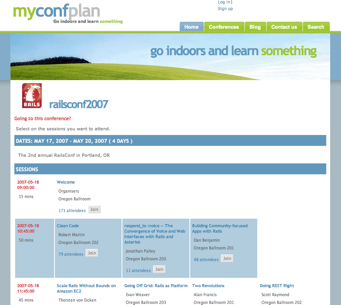
I constantly get mails from various readers who are looking for Rails developers for their projects. As I don't do this myself, I have to keep giving out a list of Rails developers I know and trust or have had good feedback about. I figured I should make a blog post with a list instead, so I could point people to it, and keep it updated as a resource for everyone to use. You can even leave "review" type comments if you've used any of these guys. The list is not very long, but here we go..

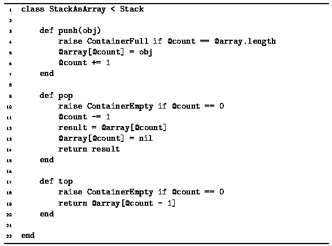
Data Structures and Algorithms with Object-Oriented Design Patterns in Ruby is an online book (free to read!) by Dr. Bruno R. Preiss, an incredibly well qualified engineer and computer scientist. It covers all of the various data structures and algorithms that beginning Computer Science students have to learn, but from a Ruby perspective and using object oriented design patterns.
The book itself is now a few years old, but I've only just come across it and it still seems relevant although, rather sadly, the on-page code is in graphics only (a ZIP file containing the source is available) and feels like a line-by-line conversion from C++ rather than true Ruby code. Still, if computer science, data structures, and algorithms elude you to any degree, and you want to learn about them while following Ruby code, it's a good place to start. There are also versions for C++, Java, C# and Python available from Bruno's homepage.
Slideshare is like the YouTube or Scribd of presentations and slideshows and it features a few good Ruby and Rails related slideshows that are worth flicking through. This post links to some of the best:


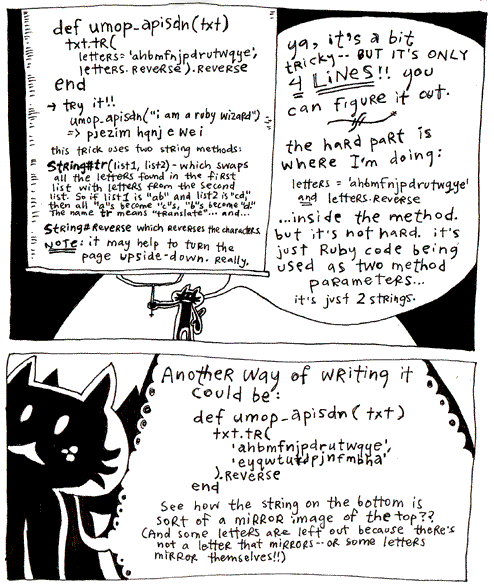
illustration: why, photographer: rooreynolds

I'm currently putting together the list of publications that my publisher, Apress, can send and push my book to. Unfortunately Ruby has a rather lacking publishing ecosystem, but I figure I'd try "ruby magazine" in Google none the less.
Following on from the bumper Ruby interpreter performance tests by Antonio Cangiano two weeks ago, Xue Yong Zhi decided to run the same performance suite on XRuby Ruby to JVM compiler and found that XRuby is faster than the Ruby interpreter in 26 out of 38 tests. It's interesting to note that the failing tests are the same as those for the official Ruby interpreter on Windows (stack exhaustion?) so in the scope of these performance tests XRuby appears to be more feature complete than interpreters such as Cardinal and Rubinius that fail many of the tests.

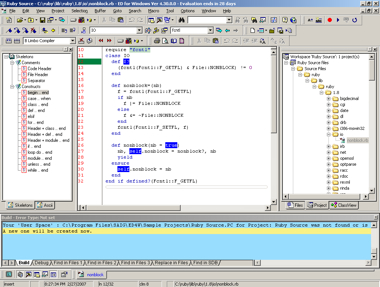
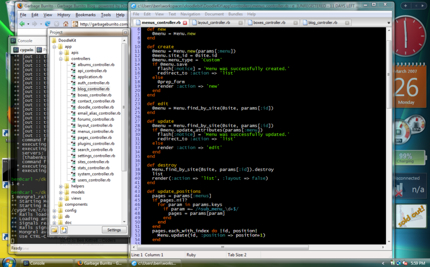
I'm not a big IDE or a Windows user myself, so getting me to review a Windows-based IDE could be quite tough. However, the creator of ED, Neville Franks, is an Australian-based independent software developer (trading as Soft As It Gets) and wrote such a nice e-mail that I felt obliged to take a look.
ED is a Windows-only editor with over 20 years' of history, having first been commercial released in the 80s, crammed with features a lot of developers seem to love, and with support for about twenty different programming languages out of the box. The latest is Ruby which Neville has so far been impressed with. ED performs code completion (ending of blocks, if statements, etc), syntax highlighting, class navigation, and all of the features you'd usually expect an IDE to boast. Neville has written a comprehensive blog entry covering ED's support for Ruby, where he demonstrates each of these features.
This post just links to a few Ruby videos I've found on Google Video that I hadn't seen before.
Charles Nutter is asking for help in squashing Rails bugs with JRuby. It seems full support for Ruby on Rails with JRuby is only just over the horizon, with over 90% coverage of ActiveRecord and ActiveSupport so far. Charles provides instructions on how to set up Rails with JRuby and run your own tests.
Josh Susser is reporting on Mark Carey's announcement that the "SDForum Ruby Conference" (informally known as the Silicon Valley Ruby Conference) is now requesting papers for the conference taking place between April 21-22, 2007. Interested parties can submit their proposals to proposals2007 [at] rubysf [dot] net. All proposals submitted before February 4, 2007 will be given consideration, and those submitted after then may not, so if you want a chance to give a presentation, you need to be quick!

License: Creative Commons Attribution-ShareAlike 2.0. Copyright, Why The Lucky Stiff.