RailsInstaller is a new project from Wayne E Seguin (of RVM fame) that brings RubyInstaller-style simplicity to getting Ruby and Rails set up on Microsoft Windows (XP, Vista, or 7). In a single wizard-driven installation you get Ruby 1.8.7-p330 (with DevKit), Rails 3.0.3, Git, and SQLite 3.
Back in August, Microsoft seemed to get tired of IronRuby so its project leader Jimmy Schementi jumped ship while asking the Ruby community to step up and get involved in its future. Today, Microsoft has announced new leadership for IronRuby (and IronPython) and has effectively jettisoned it into the community as a true fully open source project.
Three years after Microsoft first announced it was dipping a toe into the Ruby implementation waters, IronRuby 1.0 has been released. IronRuby is Microsoft's attempt at bringing Ruby natively to the DLR that runs on top of .NET (and Mono), and with version 1.0, it has finally reached maturity with Jimmy Schementi calling it the "first stable version."
IronRuby is an open source Ruby implementation being developed at Microsoft with the .NETCLR in mind. It's reasonably mature and as well being a regular implementation, it provides the ability to use Ruby directly within the Web browser through Microsoft's Silverlight Flash-esque framework. Windows seems to get a bad rap in the Ruby community so we thought we'd turn the spotlight on some of the cool things IronRuby's doing nowadays.
RubyMine is a Ruby and Rails IDE (for Windows, OS X, and Linux) by JetBrains, the guys behind the popular Java IDE IntelliJ IDEA. We've previously posted about how much people seem to like RubyMine, and it looks like things will get even better, as they've just released the beta of RubyMine 2.0. Notably, RubyMine 2.0 will be free to existing 1.0 users as it falls within the year allowed for free updates!
Adam Sanderson has written an extremely useful RubyGems plugin called open_gem. It makes it really quick to inspect what's inside your gems, e.g.: gem open rails. You'll need to be running RubyGems 1.3.2 first.
Microsoft's got plans for Ruby beyond the fine IronRuby project in the shape of "ARAX" (Asynchronous Ruby and XML), a Ruby-flavored variety of the popular AJAX Web development techniques. Microsoft's Silverlight plugin will be able to process and run Ruby code that's directly within Web pages similar to how browsers process JavaScript. This allows Ruby developers to write Ruby code instead of the equivalent JavaScript as they do now.
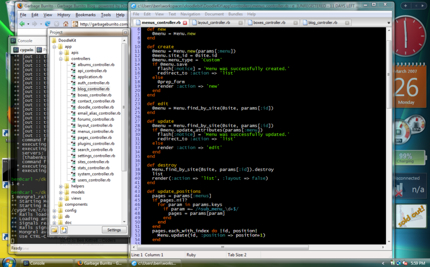
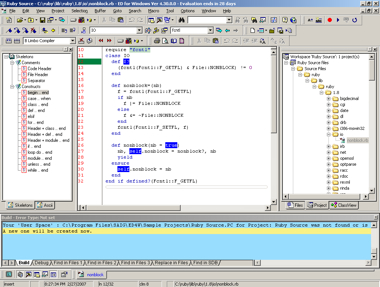
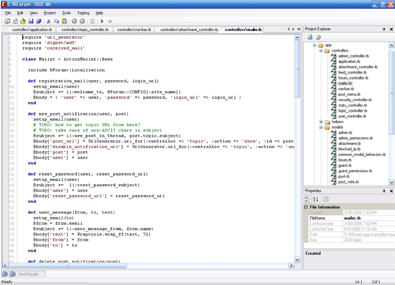
I'm not a big IDE or a Windows user myself, so getting me to review a Windows-based IDE could be quite tough. However, the creator of ED, Neville Franks, is an Australian-based independent software developer (trading as Soft As It Gets) and wrote such a nice e-mail that I felt obliged to take a look. ED is a Windows-only editor with over 20 years' of history, having first been commercial released in the 80s, crammed with features a lot of developers seem to love, and with support for about twenty different programming languages out of the box. The latest is Ruby which Neville has so far been impressed with. ED performs code completion (ending of blocks, if statements, etc), syntax highlighting, class navigation, and all of the features you'd usually expect an IDE to boast. Neville has written a comprehensive blog entry covering ED's support for Ruby, where he demonstrates each of these features.
Softies on Rails is a popular Rails blog that looks at Ruby on Rails from the perspective of .NET developers. They've just announced that they're holding a special one-day workshop where they cover how they went from .NET to Ruby on Rails for Web development and how other .NET developers can do the same.
RubyForIIS is a package that helps you set up the bindings between Ruby, Rails, and Microsoft's IIS server system. Project founder, Boris Leenaars, says:
There are a few efforts to develop crossovers between .Net and Ruby, but Ruby.NET one that is creating a compiler for the Ruby language that targets the .NET CLR in much the same way as JRuby targets the Java Virtual Machine. This particular implementation is unique in that it can pass all 871 tests in the samples/test.rb of Ruby 1.8.2.
Steve Yegge explains how to use Ruby to script your Windows applications. His first example demonstrates how to load Internet Explorer, get it to navigate to a certain Web page, and scrape the content in just five lines of code, like so:

 RailsInstaller is a new project from Wayne E Seguin (of RVM fame) that brings RubyInstaller-style simplicity to getting Ruby and Rails set up on Microsoft Windows (XP, Vista, or 7). In a single wizard-driven installation you get Ruby 1.8.7-p330 (with DevKit), Rails 3.0.3, Git, and SQLite 3.
 Back in August,
  Three years after Microsoft first announced it was dipping a toe into the Ruby implementation waters,