Breaking news! At JRubyConf 2012 (a 3 day JRuby-focused conference in Minneapolis) it has just been announced that JRuby core team members Thomas Enebo and Charles Nutter are moving from Engine Yard to open source giants Red Hat.
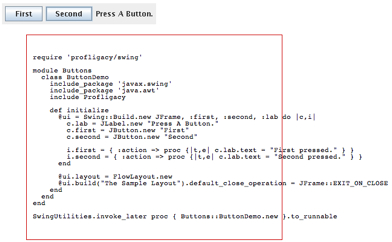
Ruby isn't known for its game development chops despite having a handfulofinterestinglibraries suited to it. Java, on the other hand, has a thriving and popular game development scene flooded with powerful libraries, tutorials and forums. Can we drag some of Java's thunder kicking and screaming over to the world of Ruby? Yep! - thanks to JRuby. Let's run through the steps to build a simple 'bat and ball' game now.
It's a newsflash! JRuby 1.6.0 has been released today. Congratulations to the JRuby team. 1.6 is a significant and much awaited release and comes after a 9 month push of over 2500 commits.
The JRuby team has announced the release of JRuby 1.6.0 Release Candidate 1. The final release is still a little way off but the bulk of the work is in place. It's billed as the "largest release of JRuby to date" which, given how awesome 1.5 was, is a big deal, especially as it adds initial Ruby 1.9.2 language and standard library compatibility (though 1.8.7 is still the "default").
It's been a great year for Ruby on Android, but no one knows it. You can start writing Ruby apps for Android devices TODAY. You don't need to install any SDK, you don't need to install some giant Eclipse IDE, and you certainly don't need to write any Java.
JRuby is undoubtedly the most mature of the alternative Ruby implementations. Supporting Ruby 1.8.7 and 1.9.1 (mostly!) and JIT compilation, JRuby is already in use in mission critical Ruby apps and runs scarily fast on the JVM. In this interview with JRuby core member, Charles Nutter, we dig deep into what makes JRuby tick.
Most Ruby developers should be familiar with Rack, an interface / library that abstracts away a lot of the banalities of hooking up application code to HTTP servers. It's used by several Ruby Web application frameworks already, some as a default - such as Merb, and others as an optional extra - such as Rails. Rack is significant because it provides a standard for Web-facing Ruby applications and frameworks to adhere to and is rapidly becoming the de-facto standard in this space.
Thomas Enebo of the JRuby team has announced the release of the first beta of JRuby 1.1. This is a significant release, focusing heavily on performance increases. The performance increases yielded so far are so significant that in most like-for-like tests, JRuby beats the regular Ruby interpreter (a.k.a. MRI) JRuby 1.1. On Rails-focused tests, JRuby also wins.. making JRuby the fastest way to run Rails applications at present. Charles Nutter talks about the improvements, along with a number of other interesting JRuby-related topics, in his latest blog post - a must read for Ruby implementation nuts.
JRuby, a Java implementation of the Ruby interpreter, has reached version 1.0. A massive congratulations are due to the team. At the time of writing, the release has not been announced on the official site, but you can download the final build. JRuby originally came into being in 2001 as a simple Java port of the Ruby 1.6 code, but has blossomed into a free-standing project that has chosen to innovate in its own way. In September 2006, Sun "acquired" the JRuby project by bringing its then two main developers on board, and since then work appears to have continued at a rapid pace. With the release of 1.0, the team claim that applications 'will just work' and that most compatibility bugs have been eradicated.
Just a couple of weeks ago, the XRuby team released XRuby 0.2.0. XRuby is Ruby-to-Java bytecode compiler, so you can compile Ruby source code directly to Java classes. The latest version fixes several issues and adds debugging support.
Victor Igumnov has put together a simple walkthrough of how to package a Rails application into a single WAR file to run on a Tomcat server using JRuby, a pure Ruby PostgreSQL library (no ActiveRecord-JDBC needed!), and GoldSpike (JRuby addon that provides rake tasks to make WAR files). This is useful knowledge for anyone who might be forced into deploying Rails apps in an enterprise type system where Tomcat may be the only viable deployment option.
On behalf of the whole JRuby team, Thomas Enebo has announced the release of JRuby 0.9.8. Hundreds of minor tweaks, fixes, and features have been added, and now Ruby on Rails is officially supported. The team report a 98% pass rate for Rails 1.2.1's own unit tests, and if you've seen how deep the Rails tests go, that's pretty good work. It's pretty clear JRuby isn't too far from a 1.0 release now from which full compatibility should be available.
Charles Nutter is asking for help in squashing Rails bugs with JRuby. It seems full support for Ruby on Rails with JRuby is only just over the horizon, with over 90% coverage of ActiveRecord and ActiveSupport so far. Charles provides instructions on how to set up Rails with JRuby and run your own tests.

 Breaking news! At JRubyConf 2012 (a 3 day JRuby-focused conference in Minneapolis) it has just been announced that JRuby core team members Thomas Enebo and Charles Nutter are moving from Engine Yard to open source giants Red Hat.
 It's a newsflash!
  The JRuby team has
  Following on five months after the release of the popular JRuby 1.4, the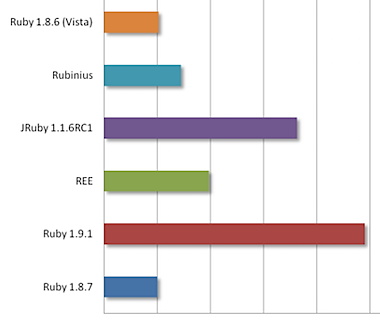

 Most Ruby developers should be familiar with