Heroku, a popular Ruby webapp hosting platform that's picked up $13m in funding, has today unveiled their new Facebook App package. The package is aimed squarely at people wanting to develop Facebook apps and brings together several of Heroku's main offerings in a single, discounted monthly package.
Ruby Quicktips is a Tumblr-powered tumblelog (think of a blog but in bite-sized chunks) by Daniel Pietzsch that presents a growing array of Ruby related tips and interesting code snippets. Daniel seems keen for you to contribute, and you can do so on its submissions page. There's an "about us" post if you want to learn more in general.
Heroku is a Ruby webapp hosting service that we first mentioned about two years ago. It started off as an online IDE of sorts, but is now a complete cloud platform for running Ruby webapps. You can develop locally and then, with a single command, deploy your app to their metered service. Well, Heroku got in touch with me last week to talk about their new "Add-Ons" feature and they've really kicked things up a notch for people wanting to quickly roll out webapps online.
The Ruby Toolbox gives Ruby developers a categorized overview of 100 or so different libraries ranked on how commonly used they are. It's not perfect as it only pays attention to projects hosted on Github and the ranking system is based on the number of watchers and forks they have, but it's enough to give you a basic overview of the activity within a certain area.
When it comes to developing large systems with many interdependent parts, it’s common nowadays to use “queues.” A queue is, for the most part, just a list that you can add items to and remove items from. Apps can use queues to despatch jobs / tasks to other apps or to shuttle logs and status information around.
RubyMine is an all new IDE for Ruby and Rails developers, developed by JetBrains (best known for Java IDE IntelliJ IDEA). RubyMine is built upon the IntelliJ IDEA platform and brings together all of the essential features you'd expect of an IDE (editor, debugging tools, source control integration, code completion, and so forth) along with lots of extra goodies specific to Ruby, such as GUI-based support for RSpec and Test::Unit.
Scott Fleckenstein has developed a plugin for Ruby on Rails called Exceptional that 'brings exception handling into the world of Rails filters'. The code speaks for itself on this one:
I don't know much about Oracle, but many people have asked about Ruby's support for Oracle. One of my clients is also attempting a project with Rails and Oracle. Here are some useful resources I've found:
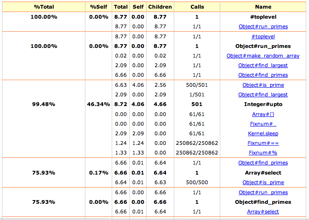
Railsbench, by Stefan Kaes, is a collection of scripts that makes benchmarking a Rails application quick and easy. Rather than benchmark over HTTP, Railsbench tests the 'raw' speed of your application directly, and won't include latencies involved with the network or between your HTTP daemon and Rails. If you love statistics, you'll love Railsbench. Here's some demonstration output:
BackgrounDRb, by Ezra Zygmuntowicz, is a system that lets you run long running tasks in the background, and not in the scope of your application. For example, you might have a Rails application that needs to send 100 e-mails, but rather than tie it to an HTTP request, you can simply pass off the job to a BackgrounDRb object and let the user know everything is proceeding as planned. There's more information here.
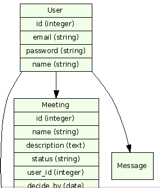
There's been talk about producing something like this in the Rails community, and it seems someone has finally done it.. a Rails Application Visualizer. Simply run a rake task and it produces a graphic showing your models and how they relate to one another. It requires the GraphViz library to run, and is only in its early days. Looks promising though!

 Heroku, a popular Ruby webapp hosting platform that's picked up $13m in funding, has today unveiled their new Facebook App package. The package is aimed squarely at people wanting to develop Facebook apps and brings together several of Heroku's main offerings in a single, discounted monthly package.


 When it comes to developing large systems with many interdependent parts, it’s common nowadays to use “queues.” A queue is, for the most part, just a list that you can add items to and remove items from. Apps can use queues to despatch jobs / tasks to other apps or to shuttle logs and status information around.