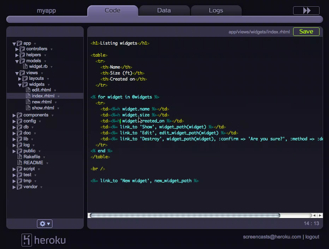
Heroku: An Online Rails Development and App Hosting Environment

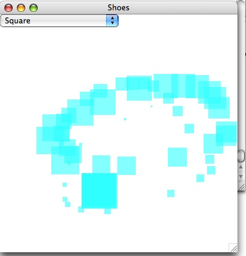
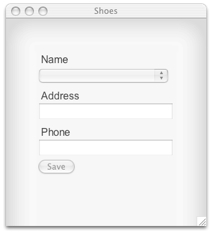
Will Larson has put together a great "from start to finish" tutorial on building a graphical application on OS X using Shoes, the cross platform GUI library by whytheluckystiff. It goes right from explaining what Shoes actually is, through to its installation, some basic examples, and then to building a basic graphics-focused application.
Thanks to an article called "Top Programming Books on Google Book Search", I've discovered that many of the pages of my book, Beginning Ruby (available also in e-book format here), are available here on Google Book Search. Most of Chapter 3 is there, along with chunks of every other chapter, including quite a bit of Chapter 16, a reference of "Useful Ruby Libraries and Gems".
Ryan Bates is being a total champ in rolling out more and more consistently good Rails related screencasts for free at RailsCasts.com. Some of the latest include:


Tracking Down a Rails App Memory LeakTom Copeland posts about how he tracked down a memory leak in a Rails application. The results are interesting. RubyGems Runs on Ruby 1.9-ishEric Hodel reports that all of the tests for RubyGems now pass on Ruby 1.9 and that a 1.9 compatible beta version will be due shortly.R2Check - Tiny app that checks your pre-Rails 2.0 apps for compatabilityMislav Marohnic has built a pretty cool Ruby script that checks the source code of a Rails app for compatibility with Rails 2.0 and then points out the changes required.Advice for Ruby Beginners - Part 1Satish Talim has posted the first part of mass interview with 13 Ruby gurus with questions surrounding topics important to Ruby newbies. The "gurus" (quoted because I'm in the list) include Jamis Buck, Jamie van Dyke, Ola Bini, and a whole range of people from a stunningly diverse array of countries.RubyForge vs CPANDaniel Berger does a quick comparison of Perl's infamous CPAN library and code repository with Ruby's own RubyForge. I was pretty surprised at the numbers.. it seems RubyForge is not only winning on quality but for the size of the Ruby community versus the Perl community, the quantity is amazing.
Nakul Aggarwal and Ritesh Arora have put together a concise, to the point, Ruby on Rails Security Guide that looks at how to tackle security issues in your authentication system, models, controllers, views, and elsewhere. Lots of links, lots of tips, and a must-read for anyone who's not feeling 100% confident in the security of their Rails app.



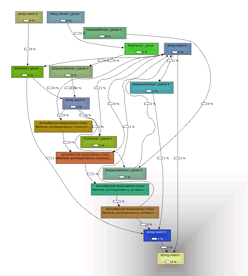
Charlie Savage, author of ruby-prof, recently baked in support for Rails to ruby-prof, so now it's possible to profile your Rails application, see where the delays are, and work on improving performance.

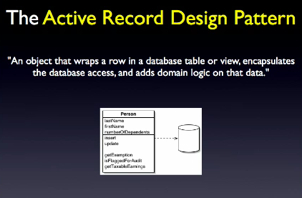
Gregory Brown has put together a great four-page tutorial on how to build a database driven console application using Ruby and ActiveRecord (no Rails needed!). As well as delivering what the title suggests, Brown also looks at some neat Ruby techniques for structuring applications in general (such as using modules and module_function). The end result is an app called "EarGTD," a basic time / task management tool.
Deplate is a Ruby-based tool written by Thomas Link to convert documents written in wiki-like markup to various output formats. Supported output formats include LaTeX, HTML, "HTML slides", DocBook (which means it can also convert to PDF, and other DocBook-supported output), and plain text.



Matthew Bass has written a tutorial, published by InfoQ, called "Automating File Uploads with SSH and Ruby." It provides an in-depth look into building a small Ruby script that can backup files to a remote machine over SSH using the Net-SSH and Net-SFTP libraries. It goes into quite some depth, and provides source code for a recursive backup script. If you haven't had a dig into the Net-SSH and Net-SFTP libraries yet, it's worth a look to see how the basics work.