Ruby == Concise Network Programming
DevX.com has published a great article by Mark Watson entitled "Ruby Programming Language Enables Concise Network Programming". Mark gives quick rationales and examples for:

DevX.com has published a great article by Mark Watson entitled "Ruby Programming Language Enables Concise Network Programming". Mark gives quick rationales and examples for:
Flickr.rb is an 'insanely easy' Ruby library to interface with the world's most popular photo-sharing service, Flickr.
Mauricio Fernandez's ever-mindblowing Eigenclass presents a great article about how to easily implement a plugin system for any Ruby application. Ruby's reflection and OO features make it a cinch.
Paul Cantrell has created a cool guide, with demonstrations, of the powers, quirks, and surprises of closures, blocks, and procs in Ruby. He writes:
Sending mail from Rails applications using sendmail or a normal SMTP daemon is easy, but GMail has posed some problems. Luckily, someone has worked it out and presents code on how to get ActionMailer sending through a GMail account.
I initially thought there was only one PayPal library for Ruby, but apparently not. Here's all those I've found:
The unstoppable Coda Hale presents an amazing article about setting up a server with Mongrel, Apache, Capistrano, SSL support, etc. for solidly serving Rails applications. An extremely well written and solid guide.

Tim Hunter, of RMagick, the Ruby Image/GraphicsMagick library, has put together a cool tutorial about how to use RMagick to produce Web 2.0 style graphics, as shown above. It's pretty in-depth.
If you want to cut down on the nastier elements getting through to your Web site, filling in contact forms, and generally causing havoc, consider the rbl_check plugin by Joost.
RubyNode is an interesting Ruby library that spits out semantic representations of code much in the same way the inspect method does with data. Here's a demo:
mly from caboo.se looks at how to quickly protect certain controller actions from GET requests in Rails, and presents a couple of useful test helpers to make testing for POST vs GET compliance simple. His code lets you then do a simple test like so:

Above: Courtenay's team hard at work.
Derek Haynes laments:
Peter Szinek has announced he's going to write a series of articles on 'screen scraping' with Ruby (more accurately, extracting data from Web pages and other online sources) and has released the first article entitled "Data Extraction for Web 2.0: Screen scraping in Ruby/Rails". He covers four basic scraping techniques, first using regular expressions, then HTree and REXML, then RubyfulSoup, and finally WWW::Mechanize. If you need to process shaky HTML sources from Ruby, read on.
Aidan Finn, a freelance Ruby on Rails developer in Ireland, has developed a quick guide to creating your own generators in Rails. Code generators in Rails are useful when you have similar patterns between controller in various projects, but aren't ready to jump into creating a Rails Engine or plugin, or where such wouldn't be relevant.
O'Reilly has just released "RJS Template for Rails" by Cody Fauser, the god of RJS templates. RJS templates are used in Ruby to create a full AJAX experience. They let you adjust and add elements onto the current page without reloading by using nice, clean Ruby code, without getting down and dirty with JavaScript.
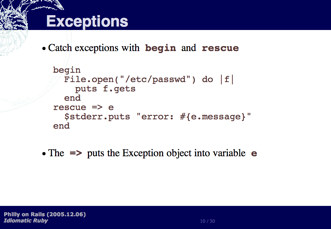
Idiomatic Ruby is an online presentation by Toby DiPasquale that goes through some of the more idiomatic features of Ruby, those that newcomers to Ruby might be confused by or overlook. It covers Modules and Mixins, Exceptions, Regular Expressions, Duck Typing, Iterators, method_missing, Continuations, Closures and Blocks, and is very concise and well put together.
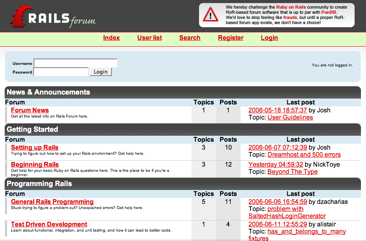
Delynn Berry has developed a useful plugin called UserStamp. Whereas Rails has built in support for automatic columns such as created_at and updated_at, it doesn't (quite rightly) support concepts such as created_by, as these belong in the application domain. It's a commonly required feature though, and Delynn has done a great job of packaging it up.
Pat Eyler of O'Reilly's Ruby blog has interviewed James Gray of Ruby Quiz fame. James talks about how he was won over to Ruby via Perl 6, and how the Ruby Quiz has continued to explode in popularity.
Stefan Kaes takes a look at common performance problems with Ruby on Rails. He looks at:
From the ever-productive Erik Veenstra comes AllInOneRuby, a "Just-in-Time and Temporary Installation of Ruby". The concept is simple:
Rather than use the send_file or send_data methods to send an entire, completed bulk of information back to the client, David N. Welton wanted to, effectively, print stuff to the client bit by bit. He worked out how to do it and presents his findings and sample code here.
Chris Anderson looks at deploying Rails apps with Capistrano and Mongrel on Planet Argon. He provides a whole pile of recipe snippets, as well as some Capistrano recipes for Mongrel 'spinner' and 'restart' tasks.