Amp is a new Ruby based project that aims to "change the way we approach VCS" (version control systems). Currently it's basically a port of the Mercurial version control system - a common alternative to the Git system that's more popular in Rubyland - but it aims to abstract things to the point where it could be used in place of Git, Bazaar, SVN, CVS, Darcs, and so forth.
MagLev is a new(ish) Ruby implementation built by Gemstone Systems that focuses on providing an integrated object persistence layer and a distributed shared cache - a truly scalable Ruby implementation. Maglev has, however, had an air of vaporware about it, having been hyped up in early 2008 and only available to a small group of alpha testers till now. That changes today with the first public, alpha release!
MacRuby, a port of Ruby 1.9 to the Mac OS X Objective C common runtime, is today one step closer to a production-ready Ruby implementation with the release of beta 2 of MacRuby 0.5. MacRuby 0.5 has been highly anticipated since it was first mentioned back in March because it promises significant performance improvements, a new LLVM based virtual machine (replacing YARV), and significant compatibility improvements and bug fixes. Even still at this beta stage, 0.5 delivers on these promises.
To date, the main ways to send e-mails from Ruby have been Net::SMTP, TMail, and Rails' ActionMailer (which uses TMail). Now, however, there's a fourth option, the simply named "mail" by Mikel Lindsaar.
Jekyll is a simple Ruby-powered static site generator, originally by Tom Preston-Werner (aka mojombo) of Github fame. It's focused around blogging, but it can be configured to generate any kind of static site. (Note: Jekyll has been around for about a year - Tom originally blogged about it in November last year, so apologies if this is old news to some readers, but I've only recently discovered it!)
Riot is a new Ruby test framework by Justin Knowlden that focuses on faster testing. Justin was frustrated with his slow running test suites, despite employing techniques such as using factories, mocks and avoiding database access. He realized that a slow-running suite makes one reluctant to run it or expand it - not good.
Boson is a new command/task framework for Ruby by Gabriel Horner (of Hirb fame). Gabriel seems to be trying to supersede Rake, the Ruby "make" equivalent, and from first glance Boson seems to provide many benefits from the "reinvent the wheel" philosophy.
Mustache is a new templating library from Chris Wanstrath (a.k.a. defunkt of GitHub fame) that provides a way to render views in your chosen Ruby web framework. Influenced by ctemplate, Mustache helps to keep your MVC layers separate by actively preventing the inclusion of application logic in your views.
RubyPulse is a screencast site that publishes regular videos about different Ruby libraries. It's a month old so far and German Ruby developer Alex Peuchert has put out 9 episodes already. With a little support, perhaps Alex will be able to keep it going and become the pure Ruby equivalent of Ryan Bates!
Today Phusion has announced the release of Ruby Enterprise Edition (REE) 1.8.7 (more specifically, 1.8.7-20090928). Once considered a bit of a joke, given the name, REE has proven itself to be anything but, with significant memory usage and speed improvements over the stock "MRI" Ruby implementation (achieved by way of patches to the MRI code). The key development with this release is compatibility with Ruby 1.8.7, rather than the 1.8.6 of previous versions.
A couple of weeks ago, popular micro-blogging service Twitter unveiled a beta "streaming API." Twitter's nature means they get hammered with polling requests so they've begun to experiment with the concept of streaming relevant data within a single HTTP request (in a Comet style). TweetStream (or GitHub repo) is a new Ruby library by Michael Bleigh to handle interacting with Twitter streams from Ruby.
Ruby Version ManagerGitHub repo (a.k.a. RVM) makes it ridiculously easy to install and switch between multiple Ruby versions on OS X and Linux. Over the last 24 hours, I've been playing with RVM and talking to creator Wayne E. Seguin and have been blown away with how cool (and simple) it is - you will definitely want to check this one out.
Sometimes taking an app down for debugging purposes is just not an option. Luckily a new tool called Hijack can provide a live IRB prompt for an existing Ruby process in the same way that Erlang provides hot swapping of code (changing the definition of a system while the system is still up and running).
In Make Your Test Suite UNCOMFORTABLY FAST! (called "the best blog post ever written" by one commenter) Jason Morrison of Thoughtbot demonstrates how to use Michael Grosser's Parallel Specs project to speed up your Ruby tests.
François Vaux has recently published a Ruby module called Rackable which allows you to make any Ruby object Rack-friendly, providing it with a REST-like interface.
A couple of weeks ago we featured Gabriel Horner's Hirb framework for formatting irb output. I've recently been playing with another of his projects, Alias, which further enhances the Ruby Console experience (but it conceivably could be used in your Ruby programs too).
Inspired by Git (the version control system), Delano Mandelbaum has come up with a library called Gibbler, which produces hashes and history for Ruby objects.
Earlier this week, Rip quietly made its way into the world. It's a "next generation" Ruby packaging system, clearly meant to both work around some of the problems with RubyGems and also introduce some fresh ideas of its own. If you want to immediately jump and learn more, check out the official About us page for a tour.
It's pretty rare I recommend new blogs to follow on Ruby Inside. Not because I don't like them - I link to their posts all the time! - but because it's hard to tell if a new blog is going to keep going and be worth your while.
Paul Dix, of Feedzirra fame, strikes again! This time with Typhoeus (Github repo), a high-speed, parallel HTTP request library for Ruby. At first glance, you could be forgiven for wondering what the point is when we already have John Nunemaker's awesome HTTParty to build simple HTTP clients, but Typhoeus is, in many ways, like HTTParty on ten cans of Red Bull.

 Amp is a new Ruby based project that aims to "change the way we approach VCS" (version control systems). Currently it's basically a port of the Mercurial version control system - a common alternative to the Git system that's more popular in Rubyland - but it aims to abstract things to the point where it could be used in place of Git, Bazaar, SVN, CVS, Darcs, and so forth.

 To date, the main ways to send e-mails from Ruby have been


 Just two months ago
 Egyptian Ruby developer Muhammed Ali (of

 Today Phusion has
  A couple of weeks ago, popular micro-blogging service
 Sometimes taking an app down for debugging purposes is just not an option. Luckily a new tool called
 In
In 
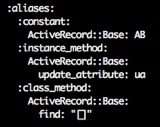 A couple of weeks ago we featured
 Inspired by

 It's pretty rare I recommend new blogs to follow on Ruby Inside. Not because I don't like them - I link to their posts all the time! - but because it's hard to tell if a new blog is going to keep going and be worth your while.
 At the last regular
  Paul Dix, of