Streamlined is a framework that sits about Ruby on Rails and makes developing Rails applications even quicker than possible with scaffolding alone. It includes a ton of useful stuff like pre-built layouts, a REST layer around all the models, support for Atom, and its own DSL. As developer Justin Gehtland explains:
Railsbench, by Stefan Kaes, is a collection of scripts that makes benchmarking a Rails application quick and easy. Rather than benchmark over HTTP, Railsbench tests the 'raw' speed of your application directly, and won't include latencies involved with the network or between your HTTP daemon and Rails. If you love statistics, you'll love Railsbench. Here's some demonstration output:
There are a few efforts to develop crossovers between .Net and Ruby, but Ruby.NET one that is creating a compiler for the Ruby language that targets the .NET CLR in much the same way as JRuby targets the Java Virtual Machine. This particular implementation is unique in that it can pass all 871 tests in the samples/test.rb of Ruby 1.8.2.
RubyNode is an interesting Ruby library that spits out semantic representations of code much in the same way the inspect method does with data. Here's a demo:
Many coders will reach a situation where developing a C extension makes sense, whether for doing 'heavy lifting', diving into assembly language, interfacing with other C code, etc. Luckily, developing a basic Ruby extension in C is easy.
KRJS is an extension to Rails views by Chew Choon Keat that helps provide a radically different mechanism for handling AJAX and RJS. He calls it "RJS without messing the views."
The RubyExamples page is a few years old now, but I just came across a great example which still works, and which demonstrates the intense power of Ruby. Please note that Justin Bishop deserves all the credit for this one.
O'Reilly has just released "RJS Template for Rails" by Cody Fauser, the god of RJS templates. RJS templates are used in Ruby to create a full AJAX experience. They let you adjust and add elements onto the current page without reloading by using nice, clean Ruby code, without getting down and dirty with JavaScript.
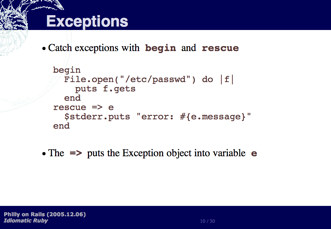
Idiomatic Ruby is an online presentation by Toby DiPasquale that goes through some of the more idiomatic features of Ruby, those that newcomers to Ruby might be confused by or overlook. It covers Modules and Mixins, Exceptions, Regular Expressions, Duck Typing, Iterators, method_missing, Continuations, Closures and Blocks, and is very concise and well put together.
Pat Eyler of O'Reilly's Ruby blog has interviewed James Gray of Ruby Quiz fame. James talks about how he was won over to Ruby via Perl 6, and how the Ruby Quiz has continued to explode in popularity.
It's not the nicest code you'll ever see, but it's a great demonstration of the power inherent in Ruby on Rails. Miklos Hollender demonstrates how he created a version of Web 2.0 app, Reddit, in under 20 minutes using Rails, scaffolding, and a little elbow grease. Source is included.
BackgrounDRb, by Ezra Zygmuntowicz, is a system that lets you run long running tasks in the background, and not in the scope of your application. For example, you might have a Rails application that needs to send 100 e-mails, but rather than tie it to an HTTP request, you can simply pass off the job to a BackgrounDRb object and let the user know everything is proceeding as planned. There's more information here.
Steve Yegge explains how to use Ruby to script your Windows applications. His first example demonstrates how to load Internet Explorer, get it to navigate to a certain Web page, and scrape the content in just five lines of code, like so:
The Charming Ruby Compiler is charming not just by name, but by nature. It's a thesis project at the Computer Science Department at Chalmers University of Technology in Sweden to develop a proof of concept Ruby compiler that compiles to the C-- intermediate language. So far, they've only got the basics working, but it's an interesting project, if only to learn about C--, an interesting 'portable assembly language' that makes life easier for compiler developers. It seems a little like Parrot, and is funded by Microsoft Research and the National Science Foundation.