In case the title of this post is giving you deja-vu, we've looked at "How To Create A Ruby Extension In C" before at Ruby Inside. We've also looked at using RubyInline to make the process even faster by not having to write a specialized C extension.
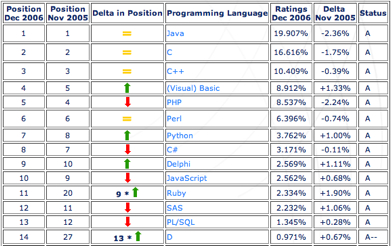
Vsevolod Balashov has taken a PHP PageRank decoder and rewritten it in Ruby. It works and it's fast. Simply, it retrieves the PageRank value for a supplied URL from Google and decodes it back to the PageRank value between 0 and 10. Each page indexed by Google has one of these numbers, and have historically represented how well linked a Web site is and how well it will rank in Google. The usefulness of PageRank has dropped a lot in the past year or two, but it can still be a useful indicator of how significant a Web site is.
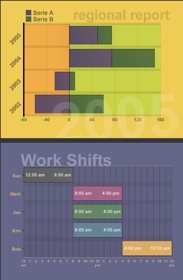
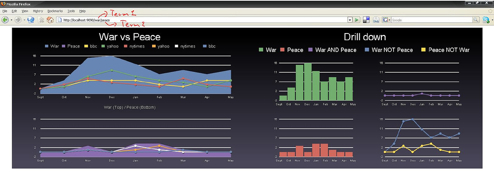
Tattle is a project from Chad Fowler, Jim Weirich, and Bruce Williams that allows you to submit information that would be useful to the RubyGem developers and, ultimately, developers of other Ruby gems. You can see charts showing the data submitted so far here.
You're about to start a new Rails project. Do you type rails <project name>? No, "Stop using the rails command", says Josh Susser. If you create a dummy / default Rails project that's set up just the way you like it with plugins, your own extensions, and all those carefully defined svn:ignore flags, you can just create a new Rails project with a simple svn copy. So simple, but I've totally missed this idea, and it's a real timesaver.
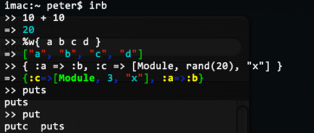
If you haven't got tab-completion and syntax coloring in your irb, you owe it to yourself to follow these instructions right away (should work for Linux, OS X, and Cygwin users). First, install the Wirble gem:
css_dryer is a Rails plugin by Andrew Stewart that makes putting together stylesheets for your Rails applications more efficient than ever before. It supports nesting and basic variable interpolation. For example, here's an example of nesting:
Dhaka is a set of tools written in Ruby by Mushfeq Khan that can generate tokenizers, parsers, and evaluators of context-free grammars (my own shabby contribution in this field was posted to RubyInside recently!). Dhaka's ultimate goal is to make a pure Ruby, flexible parser generator. From the official site:
Walter Korman has released the first version of a Yahoo! Video library for Ruby. All it takes is a gem install yahoo-video and some simple code like this:
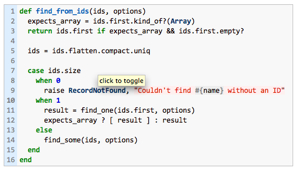
Scott Fleckenstein has developed a plugin for Ruby on Rails called Exceptional that 'brings exception handling into the world of Rails filters'. The code speaks for itself on this one: