Official project sites should set the benchmark for standards relating to that project in terms of the best quality and most up to date news updates, documentation, download links, tutorials, and so forth. On this front, Ruby's official site at ruby-lang.org is doing a bad job (in the English language variant, at least).
I don't like being negative on Ruby Inside without good reason. Trivia like DHH's test library preferences can provide a fun talking point but pointing out specific flaws in someone's work is rarely insightful.
You've given Rubinius a spin, right? And contributed code to the project? If you didn't already know, Rubinius is an 'alternative' Ruby-sorta-written-in-Ruby implementation that's production ready and has been going from strength to strength recently (I post about it quite a bit). And whatever your answers to those questions, the Rubinius team are kicking things up a notch by bribing you to get involved!
As an outspoken and opinionated guy, David Heinemeier Hansson (a.k.a. DHH), creator of Rails, is no stranger to a little bit of controversy. He frequently sets off interesting debates on Twitter from his @dhh account. The latest is, perhaps, the most involved yet and has been rattling on for a couple of hours today.
James Golick, a prolific Canadian Rubyist, has declared war on Net:HTTP's default of not checking the validity of the certificate sent by an HTTP server when making HTTPS requests. His new always_verify_ssl_certificates gemforces Net::HTTP to verify SSL certificates and doesn't allow other libraries to override this setting.
Significant and serious improvements to the core Ruby language come along as infrequently as TextMate updates. Given that TextMate has had an update recently, an important new Ruby feature was sure to be just around the corner and it is: refinements! Shugo Maeda (who works with Matz and developer of mod_ruby) presented the idea at RubyConf 2010 last month.
In The Ruby Stdlib is a Ghetto, Mike Perham argues that Ruby's "standard library" (all the libraries that come by default with Ruby installs) is old and crufty and suggests some parts that should be removed.
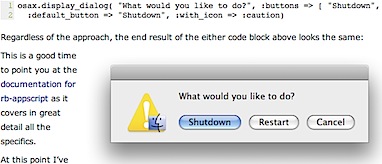
At its "Back To Mac" presentation yesterday, Apple unveiled the Mac App Store, an equivalent of the iOS App Store for the Mac. Given the relentless development and improvement of MacRuby and the power it brings Rubyists in developing complete OS X applications, I'm convinced that the time is right for Ruby to make a big splash on the OS X GUI app development front.
If you try to keep up with the Ruby community you're probably familiar with the Rails Envy podcast, even if you aren't subscribed. Well, it's just relaunched as.. The Ruby Show, hosted by Jason Seifer and Dan Benjamin. They plan to cover the latest Ruby related news on a weekly basis in a similar style to Rails Envy. New episodes come out each Wednesday.
I attended the Rails Underground conference in London at the weekend (July 24-25, 2009). As always seems to be the case at these events, I got the most value out of the more theoretical and opinion-based talks rather than 'how-to' style presentations. Having said that, Pat Allan and George Palmer gave great talks on their respective thinking_sphinx and couch_foo plugins.
Update: I retract the post Be Professional or Be Edgy: How Context Can Keep Everyone Happy of April 27, 2009 in full. It covered an issue that started as a Ruby-related thing, but quickly became focused on the behavior and sentiments of some Rails communities. Ruby Inside is a Ruby news blog; therefore my editorial was unuseful and made for dull reading. I apologize for falling into such boring territory.
It was just several months ago that we first began to mention MacRuby on Ruby Inside, but it's been coming on by leaps and bounds since then. MacRuby is a Mac OS X-based Ruby implementation that works on the Objective C runtime. It's based on Ruby 1.9 and uses the YARV VM (as Ruby 1.9 does) but will be switching to LLVM at the next major release. MacRuby is attempting to make Ruby a first class OS X development language.
Disclaimer: Every time we've run a piece about benchmarking or performance numbers on Ruby Inside, a retraction or significant correction has come out shortly thereafter. Benchmarking is hard, ugly, and quite often wrong or biased. It is not useless, however, but if you depend on the results in any way, you should certainly try to do your own benchmarking to confirm.
A week ago, Adam Nelson (a Virginia-based Ruby developer) complained about Ruby's "absolutely bullshit Ruby HTTP client situation." He was running into a nasty situation where Ruby's standard HTTP client library (net/http) was sending data in 1 kilobyte chunks, causing his CPU to redline. Due to net/http's popularity (particularly with other libraries), Adam saw this as a big issue.
This week you may have heard about "Chrome," a new Web browser being developed by Google (if you haven't, read this online comic book that demonstrates its worthiness). Associated with Chrome is V8, a new open source JavaScript engine that's designed to execute JavaScript code at never-seen-before speeds.
Microsoft's got plans for Ruby beyond the fine IronRuby project in the shape of "ARAX" (Asynchronous Ruby and XML), a Ruby-flavored variety of the popular AJAX Web development techniques. Microsoft's Silverlight plugin will be able to process and run Ruby code that's directly within Web pages similar to how browsers process JavaScript. This allows Ruby developers to write Ruby code instead of the equivalent JavaScript as they do now.
Note: This post was drafted before DHH's "The deal with shared hosts" post, but as it covers similar ground, it's worth reading too. DHH's opinion appears to be that shared hosts should put up or shut up, but I disagree and suggest this is something we need to solve as a community.

 Official project sites should set the benchmark for standards relating to that project in terms of the best quality and most up to date news updates, documentation, download links, tutorials, and so forth. On this front, Ruby's official site at ruby-lang.org is doing a bad job (in the English language variant, at least).
 I don't like being negative on Ruby Inside without good reason. Trivia like
  You've given
  As an outspoken and opinionated guy,
  Significant and serious improvements to the core Ruby language come along as infrequently as TextMate updates. Given that TextMate has had an update recently, an important new Ruby feature was sure to be just around the corner and it is:
  In
In  At its "Back To Mac" presentation yesterday, Apple unveiled the
  If you try to keep up with the Ruby community you're probably familiar with the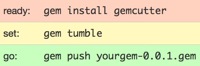

 I attended the
  Update: I retract the post Be Professional or Be Edgy: How Context Can Keep Everyone Happy of April 27, 2009 in full. It covered an issue that started as a Ruby-related thing, but quickly became focused on the behavior and sentiments of some Rails communities. Ruby Inside is a Ruby news blog; therefore my editorial was unuseful and made for dull reading. I apologize for falling into such boring territory.
 It was just several months ago that we
 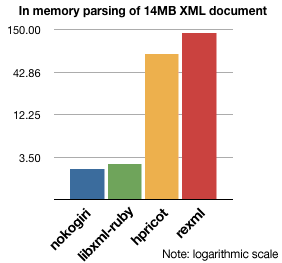 Disclaimer: Every time we've run a piece about benchmarking or performance numbers on Ruby Inside, a retraction or significant correction has come out shortly thereafter. Benchmarking is hard, ugly, and quite often wrong or biased. It is not useless, however, but if you depend on the results in any way, you should certainly try to do your own benchmarking to confirm.
 A week ago, in a story published by eWeek.com, Darryl K. Taft asked "
 A week ago, Adam Nelson (a Virginia-based Ruby developer)
  This week you may have heard about "